




































byMass General Brigham
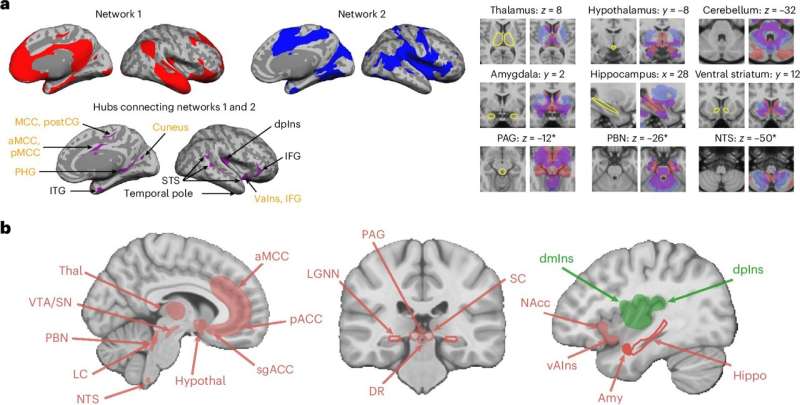
Key cortical and subcortical regions involved in interoception and allostasis. Credit:Nature Neuroscience(2025). DOI: 10.1038/s41593-025-02087-x
Using an ultra-high-resolution imaging technology called 7 Tesla functional MRI (fMRI) on human participants, researchers have mapped how different parts of the brain work together. Specifically, they discovered a unified network, or group of brain regions, that supports both body regulation (allostasis) and internal sensing (interoception).
The paper, "Cortical and subcortical mapping of the human allostatic-interoceptive system using 7 Tesla fMRI," ispublishedinNature Neuroscience. Jiahe Zhang, Ph.D., of the Department of Psychiatry at Mass General Brigham, is the lead author of the paper. Lisa Feldman Barrett, Ph.D., and Marta Bianciardi, Ph.D., of the Department of Radiology at Mass General Brigham are co-senior authors. Barrett is also affiliated with the Department of Psychiatry at Mass General Brigham.
Previous studies in both animal models and humans have pointed to the existence of a distributed system in the brain that helps it anticipate and prepare for the body's energy needs—a process called allostasis—as well as monitor the sensory conditions inside the body, known as interoception.
In their new study, the researchers used 7 Tesla fMRI to measure how signals across the brain fluctuate in sync over time, forming a network of regions that work in concert to coordinate actions.
In an earlier study using 3 Tesla fMRI, Barrett's team mapped a network supporting allostasis and interoception in the human brain, but the comparatively limited spatial resolution and sensitivity of the 3 Tesla technology made it difficult to fully capture the system's smaller structures in the brainstem, which are known to play a key role in these processes.
To address these challenges, they used the 7 Tesla MRI scanner at Mass General Hospital's Athinoula A. Martinos Center for Biomedical Imaging, allowing them to see small brain regions with far greater precision. Participants were scanned "at rest" so that the observed brain activity was more reflective of spontaneous allostasis and interoception than responses to external stimuli.
The researchers also used a recently validated map of deep brain areas, developed by Bianciardi's team, that was created using the brain scans of living humans. This in vivo atlas, Brainstem Navigator, maps the regions involved in regulating the autonomic, immune and endocrine systems.
The analytic approach was guided by decades of basic research that has identified two main brain pathways in mammals: one set of pathways (allostatic) that sends signals from the brain to control the body's organs, and the other set (interoceptive) that sends signals from the body to the brain, informing it about what's happening inside us.
The findings replicated and expanded on the previous 3 Tesla work, confirming nearly all the direct connections identified in non-human mammals: 100% of those between cortical areas and 96% of those linking subcortical areas to both cortical and other subcortical areas.
As expected, they found two-way connections between the brain areas that help manage the body's needs (like theanterior cingulate cortex) and the areas that sense what's happening inside the body (like the posterior insula). This means these regions communicate back and forth, helping the brain predict and regulate what the body needs.
Mounting evidence suggests that one of the brain's central roles is to anticipate and meet the body's energy needs. The new findings place the monitoring and regulation of the body's needs at the functional core of thehuman brain, showing the close connection between mental and physical health.
This is consistent with emerging research on psychiatric and neurological disorders showing that impaired brain-body communication is an important factor contributing to both mental and physical illness.
Future work will focus on linking this allostatic-interoceptive system to other tasks, including decision-making and cognition, and identifying further connections between brain regions of interest.
More information: Jiahe Zhang et al, Cortical and subcortical mapping of the human allostatic–interoceptive system using 7 Tesla fMRI, Nature Neuroscience (2025). DOI: 10.1038/s41593-025-02087-x Journal information: Nature Neuroscience
Provided by Mass General Brigham






Post comments