




































byDana-Farber Cancer Institute
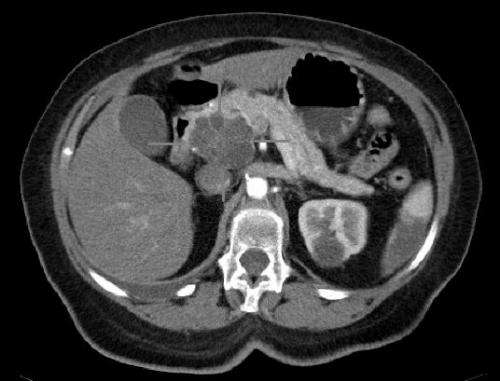
Axial CT image with i.v. contrast. Macrocystic adenocarcinoma of the pancreatic head. Credit: public domain
A shift in the way people think about and treat pancreatic cancer could be on the horizon based on positive results from the pivotal randomized Phase III RASolute 302 trial comparing daraxonrasib to chemotherapy as second-line therapy for patients with metastatic pancreatic cancer.
Results were presented in the plenary session by Brian Wolpin, MD, MPH, director of the Hale Family Center for Pancreatic Cancer Research and Gastrointestinal Cancer Center at Dana-Farber Cancer Institute at the American Society of Clinical Oncology (ASCO) Annual Meeting in Chicago on May 31, 2026, and were published simultaneously in theNew England Journal of Medicine.
Wolpin will report that daraxonrasib showed significant improvements in overall survival and progression-free survival compared to chemotherapy and was generally well tolerated with a manageable safety profile and no unexpected safety findings. The results support the use of daraxonrasib as the new standard of care for second-line treatment of metastatic pancreatic cancer.
On May 1, 2026, theFDAgranted permission for Revolution Medicines to initiate an expanded access program to daraxonrasib for patients with previously treated metastatic pancreatic cancer.
"This is the first RAS inhibitor evaluated in a large, randomized trial for patients with pancreatic cancer, and it demonstrates how important an impact these novel medicines are likely to have on the treatment of the disease," said Wolpin. "It is exciting to see that we may soon be able to help patients with metastatic pancreatic cancer in ways we haven't been able to before, improving both survival and quality of life."
Patients with pancreatic cancer often discover the disease after it has metastasized. The current standard of care for most patients is chemotherapy. Few patients survive beyond one year and a second-line standard of care chemotherapy often provides modest benefit.
More than 90% of patients with pancreatic cancer have cancer-driving mutations in theKRAS oncogenein the RAS family of genes. Daraxonrasib is an oral multi-selective RAS inhibitor that is active against the RAS mutations that commonly occur in pancreatic cancer. The medicine is given as a daily oral treatment, without any intravenous infusions.
"Given its ability to inhibit mutant and non-mutant RAS(ON) proteins, daraxonrasib has a broad applicability that has not been possible before. It is a targeted therapy that we expect to be relevant to all patients with metastatic pancreatic cancer," said Wolpin. "Were this drug to be approved by the FDA, it would mark a dramatic shift in how pancreatic cancer is treated."
Theglobal trialenrolled 500 patients with metastatic pancreatic cancer in North America, Europe, and Asia. All patients were previously treated with one line of chemotherapy for metastatic disease. Patients were randomized to receive daraxonrasib or a second-line of chemotherapy.
Patients who received daraxonrasib showed meaningful improvements in overall survival compared to those treated with chemotherapy regardless of RAS mutation status.
In the overall study population, patients who received daraxonrasib showed a hazard for death of 0.40, with a median overall survival of 13.2 months compared to 6.7 months with chemotherapy. There was also a reduction in the risk of cancer progression observed among these patients, with a median progression-free survival of 7.2 months compared to 3.6 months with chemotherapy.
Of patients with a known RAS G12 mutation who received daraxonrasib, 33.2% experienced substantial tumor shrinkage or disappearance compared to 11.8% of those receiving chemotherapy. For all patients, regardless of RAS mutation status, the objective response rate was 31.6% with daraxonrasib and 11.2% with chemotherapy.
No unexpected safety findings with daraxonrasib were discovered compared toan earlier reportfrom the Phase I/II trial. The most common side effects were rash, inflammation in the mouth, nausea, and diarrhea.
"For many years we have wanted to block mutant RAS to treat pancreatic cancer because KRAS mutations are so common in this disease and serve as a main driver for pancreatic cancer growth in the laboratory," says Wolpin. "These results suggest that the science has guided us in a productive direction, and that this first medicine that broadly targets RAS is indeed an effective therapy that has the potential to benefit many patients with pancreatic cancer."
Daraxonrasib is the first oral multi-selective RAS(ON) inhibitor to be tested in clinical trials for pancreatic cancer. It works as a molecular glue that, together with another protein, cyclophilin A, blocks the signaling of RAS proteins.
An ongoing clinical trial, RASolute 303, is evaluating daraxonrasib with or without chemotherapy as a possible first-line treatment for patients with metastatic pancreatic cancer.
Publication details Eileen M. O'Reilly et al, Daraxonrasib or Chemotherapy in Previously Treated Metastatic Pancreatic Cancer, New England Journal of Medicine (2026). DOI: 10.1056/nejmoa2605555 Journal information: New England Journal of Medicine










Post comments