




































by Paul Griffin,The Conversation
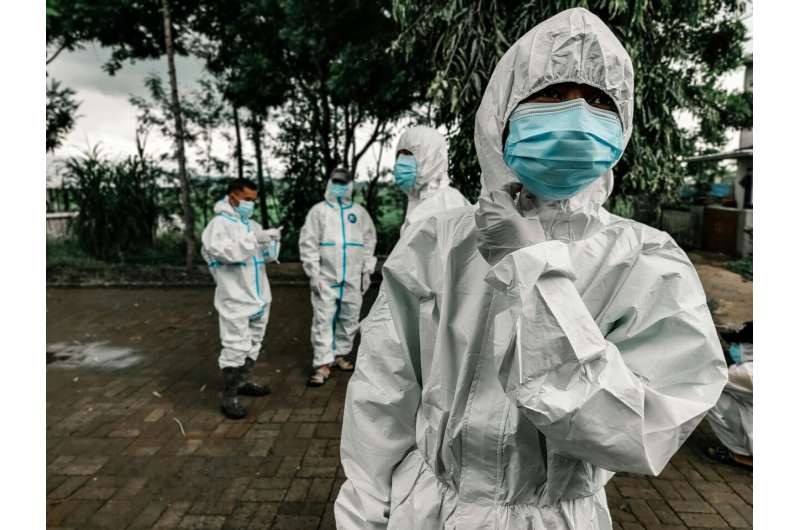
Credit: Unsplash/CC0 Public Domain
When it comes to Ebola outbreaks, it's not often we have two pieces of good news in one week. First, we heard there'snew funding of up to US$62 milliontofast-trackthe development of vaccine candidates against the type of virus circulating in the Democratic Republic of the Congo (DRC) and neighboring Uganda.
Then, we heard authoritieshad downgradedthe confirmed numbers of Ebola deaths and cases in the region.
As of June 2 local time, DRC health authoritiesreported344 confirmed cases, including 60 confirmed related deaths. Ugandahas reported15 confirmed cases, including one death. Previously, suspected cases in the region weremore than 1,000.
Here's what we know about the three vaccine candidates announced this week and why we still have a long way to go before this concerning outbreak is under control.
Don't we already have Ebola vaccines?
Yes, we have two approved Ebola vaccines. One is Ervebo, the other Zabdeno/Mvabea.
Both areeffective and approvedfor protection against the Zaire Ebola virus specifically. However, this is a different virus to the one circulating in the DRC and Uganda currently, theBundibugyoEbola virus.
Unfortunately, different types of Ebola virus have different surface proteins that the vaccine targets. This means existing vaccines against the Zaire virusaren't effective enoughto be used against the Bundibugyo virus.
Thenewly announced funding, from theCoalition for Epidemic Preparedness Innovations, aims to fast-track the development of the first, approved human vaccine specific to the Bundibugyo virus.
This support includes facilitating clinical trials as quickly as possible, so if a vaccine proves both safe and effective, it will be available as fast as possible.
Here's what we know about the three vaccine candidates.
1. IAVI vaccine
A World Health Organization (WHO) expert panelcalled this"the most promising candidate vaccine."
It's a single-dose vaccine that's being developed by the International AIDS Vaccine Initiative (or IAVI) with the University of Texas Medical Branch. It uses asimilar approachto the approved Ervebo vaccine.
The vaccine candidate has been tested inmacaque monkeys, where itwas shownto protectagainst the Bundibugyo virus.
But it hasn't yet been tested in humans. The WHO expert panel said clinical trials were likelyseven to nine monthsaway.
2. Moderna vaccine
This vaccine candidate is from the same United States-based pharmaceutical company that makes one of the approved COVID mRNA vaccines. The company also has an approved mRNA vaccine against respiratory syncytial virus, or RSV.
It's developing anmRNA-based vaccinetargeting the surface glycoprotein of the Bundibugyo virus.
The company saysthe latest funding will support preclinical studies (meaning, animal or laboratory studies) and human clinical trials.
3. University of Oxford vaccine
The third candidate is being developed by theUniversity of Oxfordand Serum Institute of India. It's based on essentially the same technology used in the Oxford/AstraZeneca COVID vaccine.
The testing of this candidate is really just starting. And the WHO expert panelsaidextra animal data was needed. Yet it said this candidate vaccine could be in human clinical trials within two to three months.
If successful, the experts noted, a single dose could be suitable for contacts of Ebola cases. However, for high-risk but unexposed populations, such as health-care workers and front-line responders, two doses might be considered.
This group has already produced vaccines againstanother type of Ebola virusthat has been tested in early phase human clinical trials.
Where to from here?
There are many challenges in developing vaccines for diseases like Ebola.
They need to be shown to be safe and effective, receive regulatory approval, manufactured at scale, then transported and delivered into people's arms.
However, given some of the challenges with vaccine uptake and the negative perception and misinformation surrounding vaccination, it can beharder to recruitpeople to vaccine clinical trials. That's especially for studies involving healthy volunteers, often conducted in countries far away from those affected.
The later phase clinical trials are typically conducted in the affected region. But these are often remote, have limited health care resources and may be in conflict zones. These make it even harder to conduct the types of clinical trials needed to show the vaccine candidates are safe and effective.
A vaccine would make a significant difference in our ability to control this outbreak. It would also be a useful tool for protecting against and responding to future outbreaks of the Bundibugyo virus.
But until we have such a vaccine, basic infection control will still be the main way to control the current outbreak.
This article is republished fromThe Conversationunder a Creative Commons license. Read theoriginal article.
Key medical concepts Ebola Vaccines Bundibugyo ebolavirus mRNA Vaccines Zaire Ebola Virus Infection Control






Post comments