




































by Anne Hammarskjöld,Karolinska Institutet
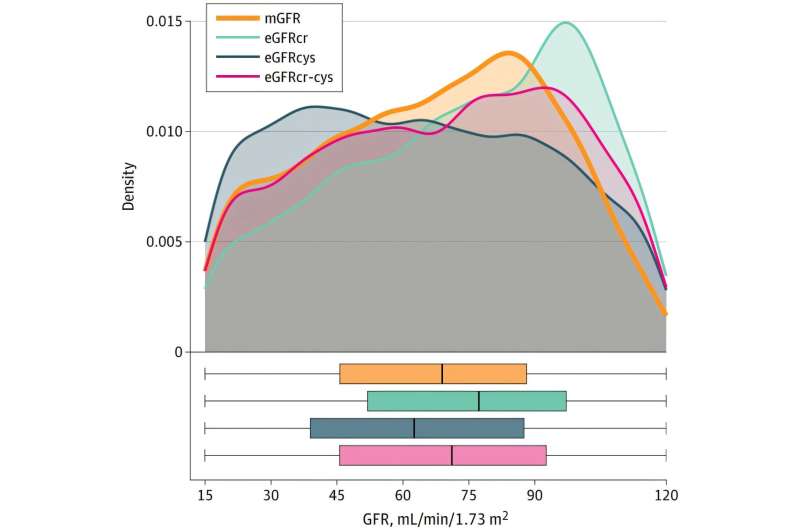
Density plot and box and whisker plot of glomerular filtration rate (GFR) distribution. Credit:JAMA(2026). DOI: 10.1001/jama.2026.9639
The thresholds for kidney function currently used to diagnose chronic kidney disease (CKD) reflect a true increase in the risk of serious illness, according to a study from Karolinska Institutet and Leiden University Medical CenterpublishedinJAMA. The researchers also show that risk assessment becomes more accurate when two common blood tests, creatinine and cystatin C, are combined to estimate kidney function.
Chronic kidney disease affects about 10%–14% of the adult population globally. Because direct measurement of kidney function, i.e., measured glomerular filtration rate (mGFR), is rarely available, clinicians rely on blood tests to determine an estimated glomerular filtration rate (eGFR).
Current diagnostic thresholds and staging are based on associations between eGFR and adverse outcomes. However, serum creatinine and cystatin C are influenced by factors other than kidney function (such as muscle mass, inflammation, and obesity), raising questions about whether these thresholds reflect risk attributable to reduced kidney function itself.
The rationale behind the new study was therefore to investigate whether the established diagnostic framework for CKD corresponds to a true increase in risk when kidney function is measured directly.
Measuring how effective the kidneys were
The study included 6,174 adults in Stockholm who, between 2011 and 2021, underwent mGFR determination using iohexol clearance testing, where a contrast agent is injected and tracked over time to measure how effectively the kidneys filter the blood. The participants were then followed for nearly six years to assess the risk of, among other things, death, kidney failure, heart failure, acute kidney injury, and cardiovascular disease.
The researchers found thatlower mGFRwas associated with progressively higher risk across all outcomes. For example, amGFR of 60ml/min/1.73m2, a threshold that diagnoses moderate-to-severe CKD, was associated with a 21% higher risk of death and nearly threefold higher risk of kidney failure compared with 90 ml/min/1.73m2.
"By confirming that theclinical framework for CKDcare truly identifies patients at higher risk of adverse outcomes, we hope clinicians renew their emphasis on screening, diagnosing and treating this disease," says Juan-Jesus Carrero, professor at the Department of Medical Epidemiology and Biostatistics, Karolinska Institutet, and the study's corresponding author.
The researchers also comparedmGFRwith eGFR equations used in routine clinical practice. The most accurate risk assessment for mortality was achieved when eGFR was calculated using both creatinine and cystatin C.
"Using both blood tests thus provides a more reliable picture of patient risk than with either test alone, supporting their combined use in clinical-decision making," says Juan-Jesus Carrero.
Publication details Edouard L. Fu et al, Measured and Estimated Glomerular Filtration Rates and Risk of Adverse Health Outcomes, JAMA (2026). DOI: 10.1001/jama.2026.9639 Journal information: Journal of the American Medical Association











Post comments