




































byTrinity College Dublin
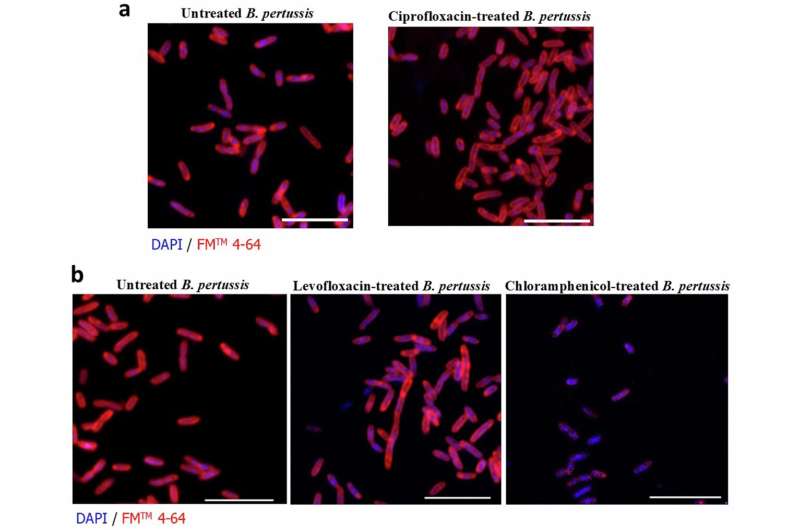
Morphology of antibiotic-treated B. pertussis. Credit:Nature Microbiology(2025). DOI: 10.1038/s41564-025-02166-6
A research team from Trinity College Dublin has unveiled a new approach to vaccination that could redefine how we protect against respiratory infections. In a studypublishedinNature Microbiology, the team demonstrate that their nasally delivered, antibiotic-inactivated Bordetella pertussis (AIBP) vaccine not only prevents severe disease but also curbs bacterial transmission—an achievement long sought by vaccine developers worldwide.
The work, led by Professor Kingston Mills and Dr. Davoud Jazayeri of Trinity's School of Biochemistry and Immunology, introduces a needle-free mucosal vaccine platform capable of inducing durable local immunity directly at the infection site. This strategy could transform both whooping cough prevention and the broader market for respiratory bacterial vaccines, addressing an urgent global need for next-generation immunization technologies.
"We've applied our understanding of protective immune pathways to engineer a fundamentally different kind of vaccine," said Prof. Mills.
"By stimulating immunity where infections begin, at the respiratory mucosa, we can offer stronger protection and potentially interrupt community transmission."
Current whooping cough vaccines, while life-saving, have key limitations: they protect infants from severe illness but fail to prevent bacterial colonization in the nose and throat, allowing continued spread within communities. Global resurgence of pertussis—despite high vaccination coverage—underscores the commercial and clinical demand for improved vaccines.
The Trinity team's innovation hinges on antibiotic-inactivated Bordetella pertussis delivered intranasally rather than by injection. This delivery route activates a distinct T-cell-driven mucosal immune response that shields both the lungs andupper respiratory tractwithout triggering unwanted systemic inflammation.
Inpreclinical studies, AIBP achieved complete protection against infection of the lungs andnasal cavity, which outperforms current acellular pertussis vaccines.
These findings suggest AIBP could serve as both a stand-alone next-generation pertussis vaccine and a "plug-and-play" platform adaptable to other pathogens such as Staphylococcus aureus, Streptococcus pneumoniae, Mycoplasma pneumoniae and Mycobacterium tuberculosis.
More information: Seyed Davoud Jazayeri et al, Respiratory immunization using antibiotic-inactivated Bordetella pertussis confers T cell-mediated protection against nasal infection in mice, Nature Microbiology (2025). DOI: 10.1038/s41564-025-02166-6 . Journal information: Nature Microbiology
Provided by Trinity College Dublin










Post comments