



































by Bial Foundation
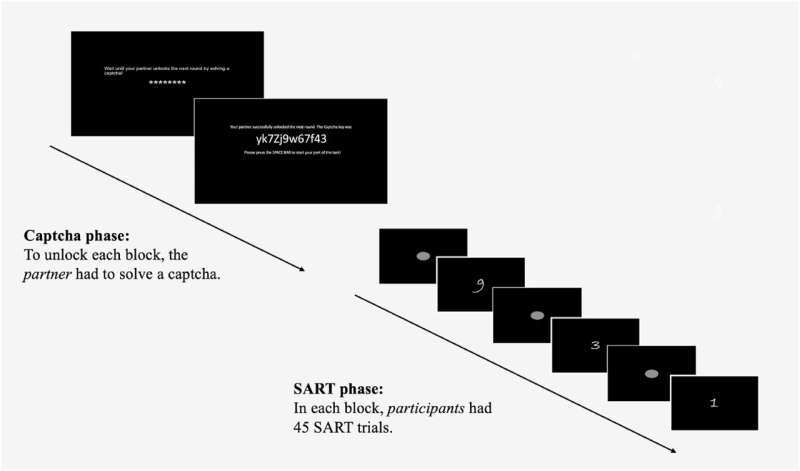
Block and Trial Structure. Each test block began with the perceived effort investment (high or low) of the partner (captcha phase) followed by 45 SART trials. Each trial commenced with the presentation of a circular gray mask in the center of the screen for 1500ms. For each trial, a digit (1-9) was displayed at the center of the screen for 500ms. Credit:New Ideas in Psychology(2026). DOI: 10.1016/j.newideapsych.2026.101250
In human sociability, cooperation occupies a central place. Compared to other species, humans cooperate with one another in a more flexible manner and across a wider range of contexts. This pro-social disposition leads us to contribute to others' goals and to shared goals, often setting aside immediate interests to benefit partners and broader social groups.
Recent research has shown thatperceiving a partner's effort(e.g., noticing that the partner worked hard before we did) can influence our own engagement and increase our sense of commitment during joint actions, leading to greater effort, persistence, and performance in tedious and demanding tasks. However, although it is known that this perception of effort increases our willingness to persist, the cognitive and motivational processes underlying these effects remain unclear.
To investigate this mechanism, a team led by John Michael, asked participants to perform a monotonous attention task. Before each task block, participants watched their "partner" solve a small visual challenge normally used to verify that a user is human (e.g., a sequence of distorted characters). When the sequence was short and quick to solve, the partner appeared to have invested little effort; when it was long and time-consuming, it suggested high effort. This simple manipulation altered only the participants' perception of the partner's investment.
In the article"True grit? The perception of a partner's effort boosts cognitive control to sustain commitment in joint action", published in the scientific journalNew Ideas in Psychology, the authors explain that after manipulating the perception of the partner's effort, they measured how participants responded to errors (post-error reaction time) in a go/no-go task. During the task, whenever participants made an error, the typical slowing down observed in subsequent trials was analyzed, an indication that the brain is boosting attentional control to regain focus.
Although the main analyses did not find clear differences between conditions, a more detailed analysis revealed a robust pattern: after making an error, participants slowed down more when they believed the partner had invested high effort. This extra slowing suggests that the brain strengthens the control mechanisms needed to recover focus and continue the task, as if it were mobilizing additional resources to avoid compromising the shared action.
"Insofar as post-error slowing is an indicator of increased supervisory attentional control, our results suggest that perceiving a partner's effort can enhance cognitive control to ward off the temptation to give up on joint action," highlights John Michael.
Overall, "the study shows that perceiving the commitment of those who cooperate with us does not necessarily make the task more enjoyable, but it strengthens the cognitive resources that help us sustain our commitment," says the researcher affiliated with Università degli Studi di Milano Statale, Italy; Central European University, Austria; and the University of Warwick, United Kingdom. This dynamic "may have practical implications for improving teamwork, collaboration in educational settings, and motivation in the face of challenging everyday tasks."
More information Marcell Székely et al, True grit? The perception of a partner's effort boosts cognitive control to sustain commitment in joint action, New Ideas in Psychology (2026). DOI: 10.1016/j.newideapsych.2026.101250










Post comments