


































by Valdemar Brimnes Ingemann Johansen, Christoffer Clemmensen,The Conversation
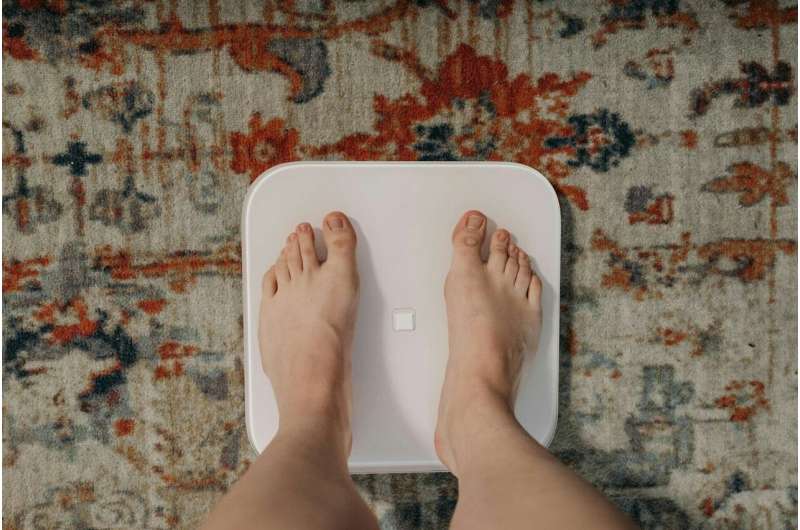
When you lose weight, your body reacts as if it were a threat to survival. Credit:Pexels/Pavel Danilyuk,CC BY
For decades, we've been told that weight loss is a matter of willpower: eat less, move more. But modern science has proven thisisn't actually the case.
More on that in a moment. But first, let'sgo back a few hundred thousand yearsto examine ourearly human ancestors. Because we can blame a lot of the difficulty we have with weight loss today on our predecessors of the past—maybe the ultimate case of blame the parents.
For our early ancestors,body fatwas a lifeline: too little could mean starvation, too much could slow you down. Over time, the human body became remarkably good at guarding its energy reserves through complex biological defenses wired into thebrain. But in a world where food is everywhere and movement is optional, those same systems that once helped us survive uncertainty now make it difficult to lose weight.
When someone loses weight, the body reacts as if it were a threat to survival.Hunger hormones surge,food cravings intensifyandenergy expenditure drops. These adaptations evolved to optimizeenergy storageand usage in environments with fluctuatingfood availability. But today, with our easy access to cheap, calorie-dense junk food and sedentary routines, those same adaptations that once helped us to survive can cause us a few issues.
As we found in our recent research,our brainsalso have powerful mechanisms for defendingbody weight—and can sort of "remember" what that weight used to be. For our ancient ancestors, this meant that if weight was lost in hard times, their bodies would be able to "get back" to their usual weight during better times.
But for usmodern humans, it means that our brains and bodies remember any excess weight gain as though our survival and lives depend upon it. So in effect, once the body has been heavier, the brain comes to treat that higher weight as the new normal—a level it feels compelled to defend.
The fact that our bodies have this capacity to "remember" our previous heavier weight helps to explain why so many people regain weight after dieting. But as the science shows, this weight regain is not due to a lack of discipline; rather, our biology is doing exactly what it evolved to do: defend against weight loss.
This is whereweight-lossmedications such asWegovy and Mounjaro have offered fresh hope. They work bymimicking gut hormonesthat tell the brain to curb appetite.
But not everyone responds well to such drugs. For some,the side effectscan make them difficult to stick with, and for others, the drugs don'tseem to lead to weight loss at all. It's also often the case that once treatment stops, biology reasserts itself—and the lost weight returns.
Advances in obesity and metabolism research may mean that it's possible forfuture therapiesto be able to turn down these signals that drive the body back to its original weight, even beyond the treatment period.
Researchis also showing thatgood healthisn't the same thing as "a good weight." As in, exercise, good sleep, balanced nutrition, and mental well-being can all improve heart and metabolic health, even if thenumber on the scalesbarely moves.
Of course, obesity isn't just an individual problem—it takes a society-wide approach to truly tackle the root causes. And research suggests that a number of preventative measures might make a difference—things such as investing inhealthier school meals, reducing the marketing ofjunk food to children, designing neighborhoods wherewalkingand cycling are prioritized over cars, and restaurants having standardized food portions.
Scientistsare also paying close attention to key early-life stages—from pregnancy to around the age of seven—when a child'sweight regulation systemis particularly malleable.
Indeed,researchhas found that things likewhat parents eat, how infants are fed, andearly lifestyle habitscan all shape how the brain controlsappetite and fat storagefor years to come.
If you're looking to lose weight, there are still things you can do—mainly by focusing less on crash diets and more onsustainable habitsthat support overall well-being.Prioritizing sleephelpsregulate appetite, for example, while regular activity—even walking—can improve your blood sugar levels and heart health.
The bottom line though is that obesity is not a personal failure, but rather a biological condition shaped by our brains, our genes, and the environments we live in. The good news is that advances in neuroscience and pharmacology are offering new opportunities in terms of treatments, while prevention strategies can shift the landscape for future generations.
So if you've struggled to lose weight and keep it off, know that you're not alone, and it's not your fault. The brain is a formidable opponent. But with science, medicine and smarter policies, we're beginning to change the rules of the game.
This article is republished fromThe Conversationunder a Creative Commons license. Read theoriginal article.
More information: Valdemar Brimnes Ingemann Johansen et al, Brain control of energy homeostasis: Implications for anti-obesity pharmacotherapy, Cell (2025). DOI: 10.1016/j.cell.2025.06.010 Journal information: Cell
Provided by The Conversation









Post comments