




































by Béatrice St-Cyr-Leroux,University of Montreal
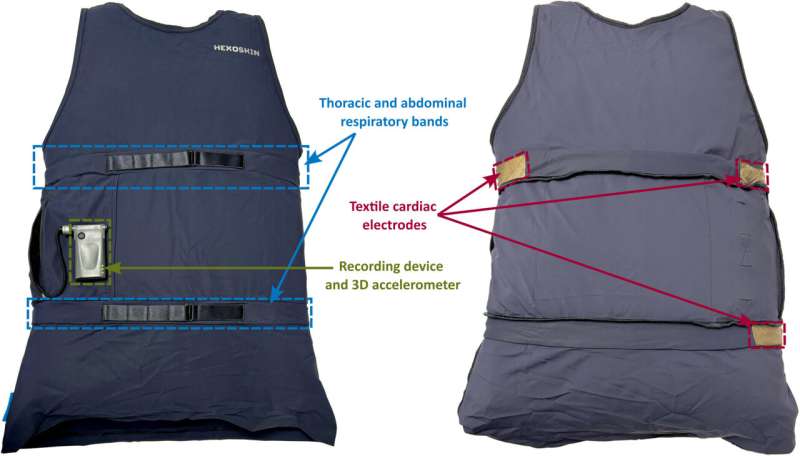
Hexoskin biometric shirt equipped with electrocardiogram sensors, thoracic and abdominal respiratory bands, a 3-axis accelerometer, and a recording device. Credit:Epilepsia Open(2025). DOI: 10.1002/epi4.70099
Epilepsy is the world's most common chronic neurological condition, affecting about 1 in every 100 people. Those who have it go into seizures of varying intensity, ranging from barely noticeable to dramatic, with convulsions and loss of consciousness.
These seizures stem from excessive electrical discharges in the brain, a kind of "neuronal storm" that, in severe cases, can disrupt breathing and cause sudden death. A more common risk is injury—sometimes evenbone fractures—from falls during seizures.
While anti-seizure medications are the first line of treatment, they don't work for about one-third of people living with epilepsy. Surgery to remove the area of the brain responsible for seizures has proven effective in a limited number of cases. For others, seizures persist despite all available treatments.
That's why researchers are now exploring other avenues, such as detecting or even predicting seizures to prevent the injuries they can cause. This is a key focus of the research of Dang Khoa Nguyen and Élie Bou Assi, both professors in the Department of Neuroscience at Université de Montréal and researchers at the CHUM Research Center.
"Detecting a seizure means realizing it's happening, like opening your umbrella when it starts raining, whereas predicting means realizing that it's coming, like knowing it's going to rain and taking an umbrella when you go out," explained Nguyen, holder of a Canada Research Chair in Epilepsy and Functional Anatomy of the Human Brain.
While prediction remains a complex scientific challenge, real-time detection is within reach thanks to devices equipped with physiological sensors that can be worn or placed next to the body.
Now, a whole range of devices—from mattresses to wristbands, shirts and shoes—are being tested in the lab for their ability to accurately, continuously and non-invasively measure breathing,heart activityand movement.
One focus of Nguyen and Bou Assi's research is a biometric shirt developed in Montreal. Originally designed for athletes, this "smart" shirt is equipped with sensors to track respiratory activity, electrodes to measure heart activity (ECG) and an accelerometer to detect abnormal movements.
Together, these data can identify the typical clinical signs of a seizure, such as respiratory abnormalities,rapid heart rateand limb tremors. Once a seizure is detected, the device can automatically alert the wearer, a loved one or a health care professional, enabling prompt assistance.
Nguyen and Bou Assi's study, nowpublishedinEpilepsia Open, found that the smart shirt can correctly detect up to two-thirds of seizures. The rate of false alarms triggered by intense, rhythmic movements was also considered acceptable.
"In our trials, we had about one false alarm every two days," said Bou Assi. "However, we were able to reduce that number by half, mainly by training our algorithms to better recognize seizures."
The next step is to test the smart shirt in real-world situations outside the hospital.
Nguyen believes this technology could significantly enhance the quality of life and safety of families living with epilepsy. For instance, children with epilepsy would be able to sleep in their own bedrooms without their parents constantly worrying about missing a nighttime seizure.
Adults with epilepsy could regain their independence, while caregivers of elderly loved ones would no longer have to worry about a seizure leaving them immobile on the floor for hours, the researchers say.
But the potential applications of the smart shirt extend well beyondepilepsy. Scientists are now exploring its potential to monitorcardiac arrhythmias, detectsleep apneaand provide continuous patient monitoring in hospitals.
The smart shirt could someday be "the hospital gown of the future," they say, capable of transmitting real-time patient data without the need for cumbersome wires. Ultimately, it could save countless lives.
More information: Jérôme St‐Jean et al, Detection of focal impaired awareness seizures using a biometric shirt, Epilepsia Open (2025). DOI: 10.1002/epi4.70099
Provided by University of Montreal








Post comments