




































by Silvia Cernea Clark,Rice University
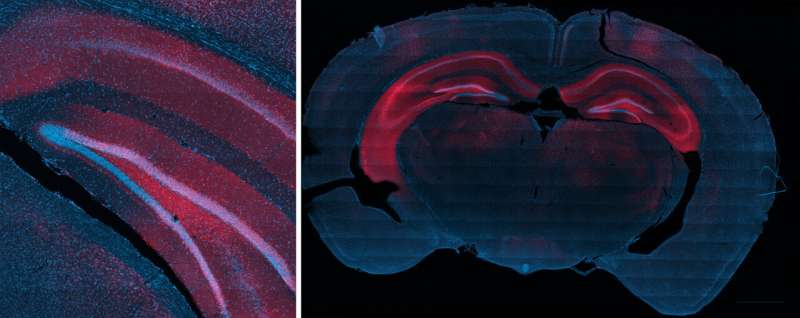
(Left) Brain section showing targeted gene delivery to the ventral hippocampus, precisely guided by focused ultrasound. (Right) Brain section demonstrating high spatial resolution gene expression achieved across the entire bilateral hippocampi. Credit: Laboratory for Noninvasive Neuroengineering / Rice University
Rice University bioengineers have demonstrated a nonsurgical way to quiet a seizure-relevant brain circuit in an animal model. The team used low-intensity focused ultrasound to briefly open the blood-brain barrier (BBB) in the hippocampus, delivered an engineered gene therapy only to that region and later flipped an on-demand "dimmer switch" with an oral drug.
The research shows that a one-time, targeted procedure can modulate a specific brain region without impacting off-target areas of the brain. It ispublishedin and featured on the cover ofACS Chemical Neuroscience.
"Manyneurological diseasesare driven by hyperactive cells at a particular location in the brain," said study lead Jerzy Szablowski, assistant professor of bioengineering and a member of the Rice Neuroengineering Initiative. "Our approach aims the therapy where it is needed and lets you control it when you need it, without surgery and without a permanent implant."
The work builds on nearly a decade of innovation by Szablowski and his team. The group'sacoustically targeted chemogenetics(ATAC) method merges ultrasound,gene therapyand chemogenetics—a technique that equips selected neurons with engineered receptors so they can be activated or silenced by a specific drug—into a single tool that makes possible precise control over brain circuits without surgery.
In the ATAC procedure, researchers first injected microscopic gas-filled bubbles into the bloodstream. When low-intensity ultrasound waves were directed at thehippocampus, the microbubbles oscillated gently against blood vessel walls, creating temporary, nanometer-scale openings in the BBB. These pores were hundreds of times smaller than blood cells, thus impeding their passage, but large enough to allow engineered gene delivery vectorsdeveloped by the Szablowski labto enter the targeted brain tissue. The pores closed naturally within hours, leaving the BBB intact.
The engineered vectors carried instructions for building an inhibitory chemogenetic receptor, a kind of molecular "dimmer switch" that makes neurons responsive to a drug administered later to "quiet" seizure-inducing activity.
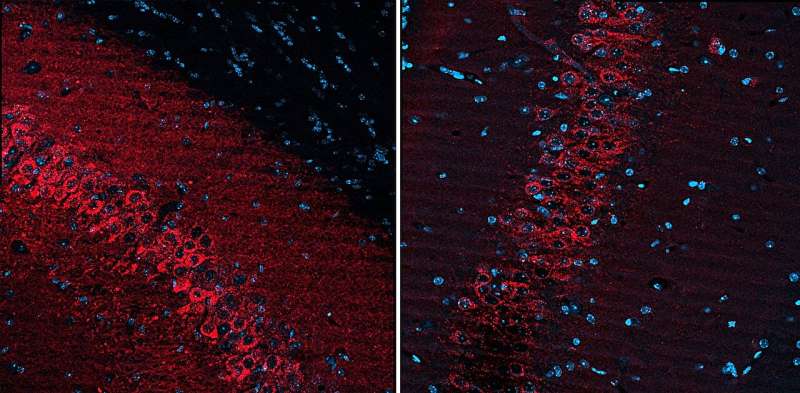
Two magnified images of hippocampus regions showing high transduction efficiency of the delivered vector. Credit: Laboratory for Noninvasive Neuroengineering / Rice University
"By precisely targeting the hippocampus, we can dampen overactivity where it matters and leave the rest of the brain untouched," said Honghao Li, a bioengineering doctoral student at Rice who is a first author on the study.
The results confirm that ATAC can achieveprecise controlover target brain circuits using a minimally invasive procedure and a simple systemic drug. Because both focused ultrasound BBB opening and viral vector-based gene delivery are already advancing inclinical studies, the method could accelerate the development of targeted treatments for epilepsy and other neurological disorders.
The hippocampus experiment marks a milestone for Szablowski's group, which has previously shown how to deliver gene therapies acrosslarge brain volumes, smalltargeted brain regionsand evenindividual neuronal connections.
Focusedultrasoundcan also be used to recover molecular signals from specificbrain regions: A related technique of the Szablowski lab known asrecovery of markers through insonation (REMIS), can release engineered or natural proteins from only the insonated region into the bloodstream, allowing researchers to monitor gene activity without invasive investigations. The technique gave rise to a clinical trial with Texas Medical Center partners, including researchers at Baylor College of Medicine and the University of Texas MD Anderson Cancer Center.
"These technologies complement each other," Szablowski said. "Ultrasound lets us deliver therapy, control the neurons we want and then measure the effects in the exact circuit we targeted. Our goal is to build a platform that can reach any brain region safely, deliver any genetic payload precisely and let clinicians control it on demand. This kind of versatility could change how we think about developing brain therapies."
More information: Honghao Li et al, Nonsurgical Control of Seizure Threshold with Acoustically Targeted Chemogenetics, ACS Chemical Neuroscience (2025). DOI: 10.1021/acschemneuro.5c00404 Journal information: ACS Chemical Neuroscience
Provided by Rice University









Post comments