




































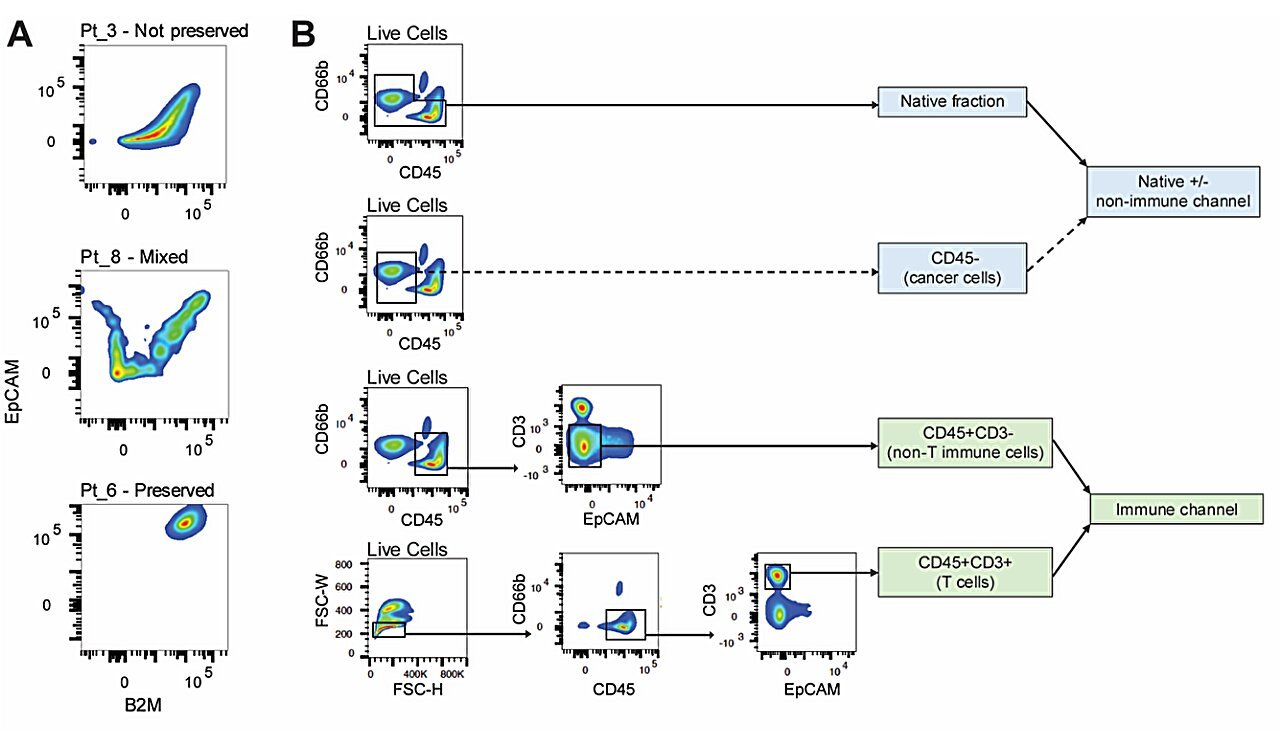
scRNAseq data generation. Credit: Science Immunology (2026). DOI: 10.1126/sciimmunol.aeb9068
In a study published in Science Immunology, researchers used malignant ascites—fluid that accumulates in the abdomen of some patients when cancer metastasizes to the abdominal cavity—to uncover immune programs associated with metastatic disease, including a rare population of RORC-expressing dendritic cells not previously linked to human cancer.
The research was co-led by Steven Blum, M.D. Gary Reynolds, M.D., Ph.D., Samuel Klempner, M.D., and Alexandra-Chloé Villani, Ph.D., jointly supervised the work at the Krantz Family Center for Cancer Research within the Mass General Brigham Cancer Institute and the Mass General Brigham Center for Immunology & Inflammatory Diseases (CIID).
Discarded fluid offers a window into cancer
When cancers spread to the chest or abdominal cavities, fluid can accumulate around vital organs. In the abdomen, this fluid is called malignant ascites. Roughly one in 10 patients with advanced solid tumors will develop malignant ascites. Ascites can cause substantial discomfort and is associated with poor responses to chemotherapy and immunotherapy.
Ascites is especially common in patients with gastric and gastroesophageal cancers, and these patients typically survive only a few months once they develop ascites. There is a considerable need to better understand why these patients respond poorly to current treatments and to develop better therapies.
For many patients, the main option to treat ascites is to repeatedly drain liters of this fluid to relieve their symptoms and then discard that material. The research team saw an opportunity to use ascites samples as a window into the biology of advanced cancer.
They realized that malignant ascites provides unusual access to the ecosystem surrounding metastatic cancer. Instead of viewing this fluid simply as a complication of late-stage disease, they asked whether it could teach us how cancer and the immune system interact in patients.
Mapping abundant and rare immune cells
The researchers initially focused on ascites from patients with gastric and gastroesophageal cancers. Then they asked whether the immune populations they discovered were also present in ascites from other cancers and at other sites of metastatic disease.
Collecting ascites and blood specimens directly from patients with stomach and esophageal cancers and developing an experimental strategy allowed the researchers to capture both abundant and rare immune-cell populations, as well as cancer cells.
They combined several complementary technologies, including single-cell RNA sequencing, which measures which genes are active in individual cells; measurements of proteins on cell surfaces; immune-receptor sequencing; and profiling of soluble proteins in blood and ascites. Altogether, the primary data set contained more than 500,000 cells. They developed a way to isolate one of the rare populations discovered from patient samples and studied these cells in primary tumors and lymph nodes.
Rare dendritic cells may promote immune tolerance
Malignant ascites is not simply fluid that has leaked out of the bloodstream and carries some cancer cells with it. Ascites is a distinct and highly organized immune environment that can influence how the immune system responds to cancer. Some of the signals they found can be targeted with existing drugs that could be repositioned for patients with ascites, potentially by giving them directly into the abdominal cavity.
One of the most striking findings was a rare population of dendritic cells that expressed the gene RORC, which the researchers termed RORC-expressing dendritic cells and abbreviated as RORC DCs. Although these cells represented a very small fraction of immune cells, they were detected in 22 of the 23 patients in the initial cohort.
What caught their attention was that these cells resemble a family of immune cells that was recently discovered in mice and humans and has been shown to help establish immune tolerance, which is the mechanism that prevents the immune system from attacking harmless substances or the body's own tissues. These cells are exceptionally rare in healthy human tissues and had not previously been connected to cancer. The experiments with RORC DCs suggest that they may represent an underappreciated cell type that promotes immune tolerance in cancer.
In normal biology, mechanisms of immune tolerance are essential—they protect us from autoimmunity and inappropriate inflammation. But cancer may be able to exploit the same biology.
The hypothesis is that, in metastatic cancer, this normally protective immune program may contribute to an environment in which T cells are less effective at attacking cancer. That gives us an entirely new area of biology to investigate.
Potential targets need further testing
The findings will not change clinical care today, but they are an important first step toward reimagining how to study, and potentially treat, patients with malignant ascites. This is a severely underserved patient population. The study identified pathways and potential therapeutic targets that the researchers are now evaluating in patient-derived models. Their hope is that the most promising approaches can ultimately be brought back to patients through clinical trials.
The discovery of RORC DCs raises the possibility that a previously underappreciated immune cell contributes to the tolerant immune environment surrounding metastatic cancer. If researchers can understand what these cells are doing, where they come from and whether their activity can be modified, they may uncover new ways to strengthen anticancer immunity.
More information: Steven M. Blum et al, Multiomic analysis of malignant ascites defines RORC -expressing dendritic cells at sites of metastasis, Science Immunology (2026). DOI: 10.1126/sciimmunol.aeb9068
Provided by Mass General Brigham
Source: MedicalXpress
Original article: https://medicalxpress.com/news/2026-10-abdominal-fluid-reveals-rare-immune.html









Post comments