




































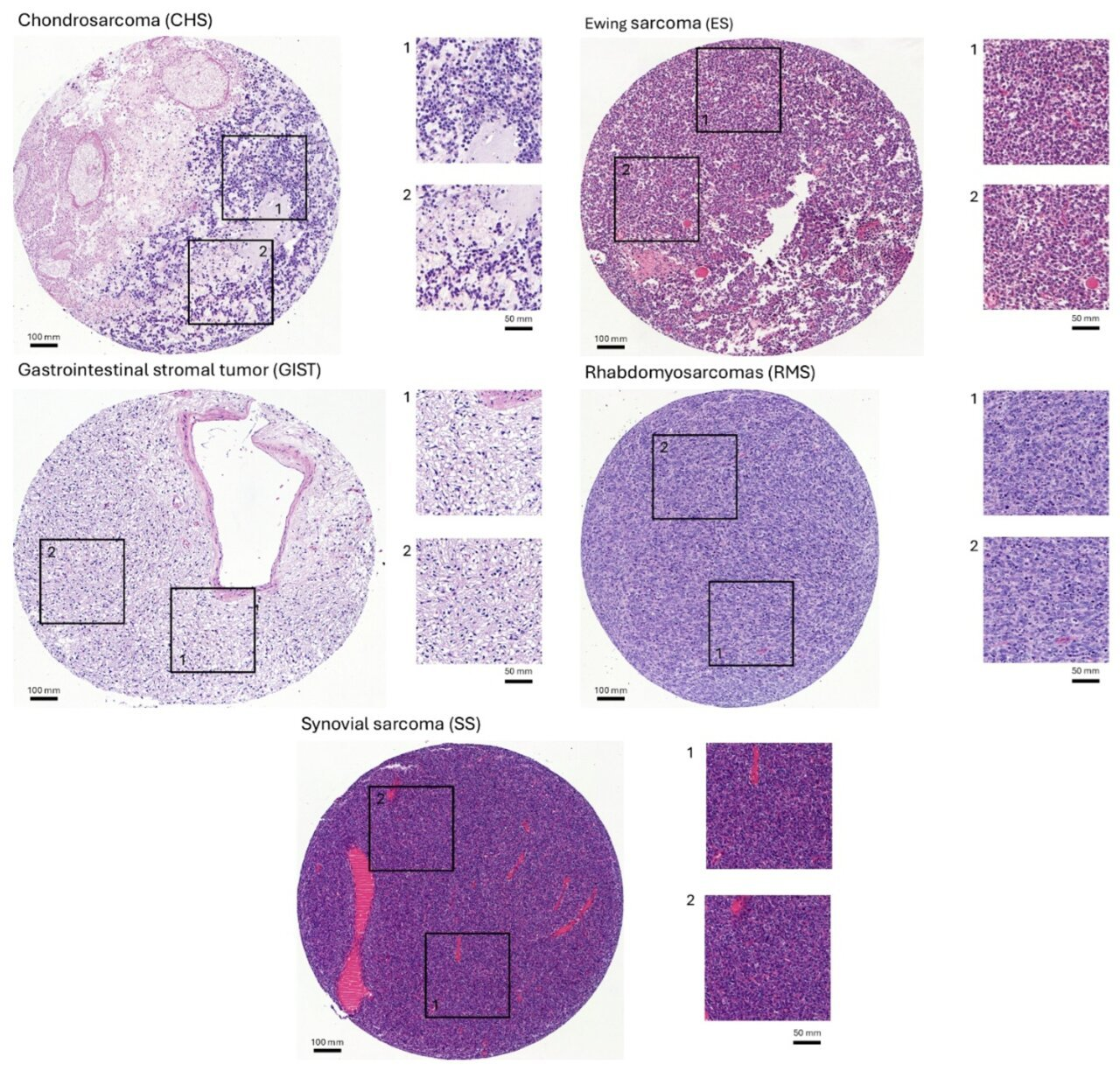
Some different selected biopsy cores of CHS, ES, GIST, RMS and SS in TMAs.
Credit: International Journal of Molecular Sciences (2026). DOI: 10.3390/ijms27156864
A team from the Universitat Politècnica de València (UPV) and the University of Valencia (UV) has developed and validated an artificial intelligence (AI) system capable of distinguishing Ewing sarcoma from other morphologically similar tumors with high accuracy. The model, which also enables optimal use of biopsy tissue, achieves 91.6% accuracy.
The study, published in the journal International Journal of Molecular Sciences, advances digital pathology by aiding the diagnosis of complex pediatric and juvenile neoplasms. It reduces errors and preserves the scarce biological material obtained during needle biopsies.
About Ewing sarcoma
Ewing sarcoma is a rare malignant tumor that primarily affects children, adolescents and young adults. It usually occurs in bone, although it can also develop in soft tissues. One of the main difficulties in diagnosing it is that, under the microscope, it can be very similar to other tumors that also originate in soft tissues, such as rhabdomyosarcoma (striated skeletal muscle), chondrosarcoma (cartilage), gastrointestinal stromal tumors (the digestive tract)—GIST, as it is known—or synovial sarcoma (joints).
Researchers from the Department of Pathology at the University of Valencia—Francisco Giner (lead researcher and first author of the article), Isidro Machado and Samuel Navarro (who is also coordinator of the Paediatric Solid Tumour Translational Research Group at the INCLIVA Institute for Health Research)—explain that "in many small biopsies, there is very little tissue. If the pathologist has an initial tool that accurately guides the suspected diagnosis, they can decide which additional and immunohistochemical tests to request, thereby avoiding using up the sample on analyses that do not provide decisive information."
AI to assist medical staff
The development of the new AI tool has been led by a team from the CVBLab research group at the Universitat Politècnica de València (UPV) and the company Artikode Intelligence, a spinoff from the UPV.
"The tool is designed to support medical staff in the field of anatomical pathology and could help guide the tests needed to confirm the diagnosis, particularly when very little tissue is available from a biopsy. Using deep learning techniques, the system identifies the microscopic patterns associated with each type of tumor and subsequently generates a classification," explains Valery Naranjo, coordinator of the CVBLab at the UPV and CTO of Artikode Intelligence.
Model training
To train and evaluate the system, the team of researchers used 1,926 digitized histological samples from 729 patients at four hospitals in Spain and Italy. These included 517 cases of Ewing sarcoma, as well as other tumors.
The system achieved an overall diagnostic accuracy of 91.6% and a sensitivity of 97.1% specifically for Ewing sarcoma. Furthermore, the model demonstrated a marginal error rate of just 1.96% between Ewing sarcoma and rhabdomyosarcoma, providing a highly reliable solution to the most challenging differential diagnosis among small round cell tumors.
Giner emphasizes that the innovative value of the work goes beyond the algorithmic technique itself. "The novelty of the project does not lie simply in using AI to diagnose Ewing sarcoma, as experimental deep learning approaches already exist in this field. Our distinctive contribution lies in the combination of the clinical problem addressed, the type of data, the classification strategy and the focus on developing a tool applicable to real-world digital pathology," he emphasizes.
He also stresses that artificial intelligence "is not intended to replace the pathologist, but rather to provide objective diagnostic support, which is particularly valuable in hospitals that do not have immediate access to the full range of molecular tests."
More information: Francisco Giner et al, Artificial Intelligence-Based Histopathological Analysis to Assist Pathologists in Diagnosing Ewing Sarcoma and Selected Tumor Entities Using Tissue Microarrays, International Journal of Molecular Sciences (2026). DOI: 10.3390/ijms27156864
Provided by Technical University of Valencia
Source: MedicalXpress
Original article: https://medicalxpress.com/news/2026-10-ai-tool-distinguishes-ewing-sarcoma.html







Post comments