




































byJustin Jackson, Medical Xpress
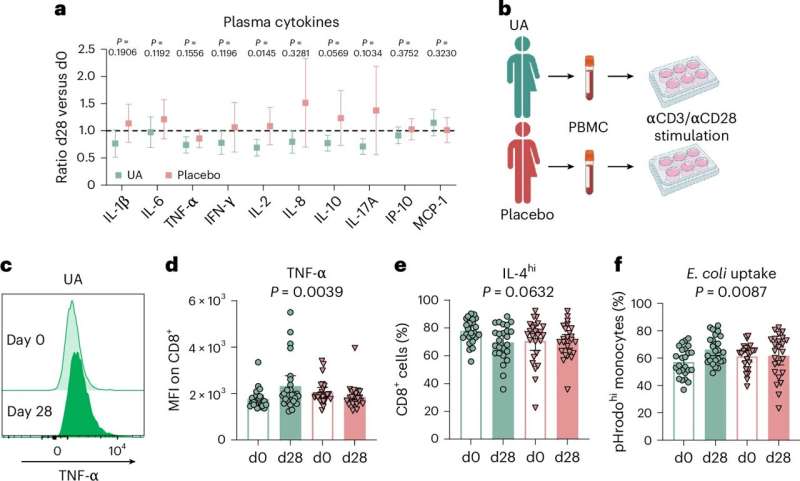
Secondary end point—UA alters inflammatory immune response. Credit:Nature Aging(2025). DOI: 10.1038/s43587-025-00996-x
An international research team focused on aging reports that urolithin A at 1,000 mg per day shifted human immune profiles toward a more naive-like, less exhausted CD8+state and increased fatty acid oxidation capacity, with additional functional gains.
Urolithin A is a metabolite produced by gut bacteria after breaking down ellagic acid from certain foods, such as pomegranates and walnuts. While produced naturally through microbial digestion, it is in much smaller quantities than available as a supplement or used in the study.
Aging bodies face reduced production of mature T cells, shrinking naive T cell pools and chronic low-grade inflammation. Mitochondrial dysfunction and waning autophagy sit at the core of these shifts, with mitophagy failure linked toimmune dysregulationand disease.
Preclinical evidence identified urolithin A as a potent inducer of mitophagy, clearing out damaged mitochondria, in rodents and humans. Previous clinical trials have reported improved physical performance following supplementation.
Immunology studies have suggested a role in regulation of CD8+T cell fate in mice, expanding T memory stem cells and naive-like T cells via mitophagy-elicited activation of the immune system. Exposure to urolithin A also conferred a favorable state on human CAR T cells ex vivo.
Improving mitochondrial quality control with a positive influence on immune function would represent a turning back of the aging biological clock, if it can have a meaningful and prolonged effect in humans.
In the current study, "Effect of the mitophagy inducer urolithin A on age-related immune decline: a randomized, placebo-controlled trial,"publishedinNature Aging, researchers designed an experiment to assess whether urolithin A can functionally remodel immune composition and metabolism over 28 days.
Fiftyhealthy adultsaged 45–70 years were randomized 1:1 to urolithin A or placebo for 28 days in a single-center, double-blind trial at Goethe University Hospital Frankfurt.
Objectives focused on phenotypic changes in peripheral CD3+ T cell subsets and immune metabolic remodeling, with prespecified secondary and exploratory endpoints across cytokines, innate populations, mitochondrial readouts, function, and single-cell transcriptional programs.
Urolithin A expanded CD8+T cells with a more naive-like phenotype and lower expression of exhaustion markers, with a statistically significant treatment difference of 0.50 percentage points. Although numerically small, such changes can indicate meaningful remodeling of immune balance over a brief 28-day period.
CD8+cells had more PGC-1α, the master controller of mitochondrial biogenesis, indicating a shift toward renewing their mitochondrial supply. Mitochondrial readouts pointed to the higher PGC-1α in CD8+cells without changes in mitochondrial mass or membrane potential.
CD8+fatty acid oxidation capacity rose with a treatment difference of 14.72 percentage points, accompanied by reduced glucose dependence.
Single-cell RNA sequencing in a subset revealed transcriptional shifts consistent with reduced exhaustion programs and altered inflammatory signaling in multiple lineages.
Short-term urolithin A supplementation modulated human immune cell composition and metabolism and improved selected functional responses, supporting the body's potential to counteract age-related immune decline.
A Research Briefing on the study was alsopublishedinNature Aging.
© 2025 Science X Network
More information: Dominic Denk et al, Effect of the mitophagy inducer urolithin A on age-related immune decline: a randomized, placebo-controlled trial, Nature Aging (2025). DOI: 10.1038/s43587-025-00996-x A natural compound revitalizes the aging human immune system, Nature Aging (2025). DOI: 10.1038/s43587-025-01012-y Journal information: Nature Aging









Post comments