





























by Peter S Millard,The Conversation
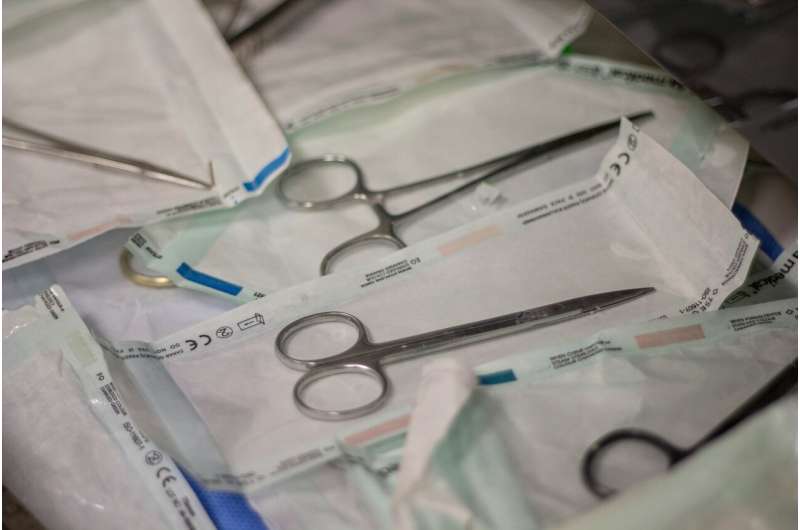
Credit: Unsplash/CC0 Public Domain
Voluntary medical male circumcision is one of the most important ways to reduce new HIV infections. The foreskin contains receptors that the HIV virus can attach to, and removing it reduces HIV transmission fromwomen to men by about 60%.
But cost and access issues have been barriers for many men and boys in southern Africa. With USfunding being cutfor HIV programs, it is increasingly important to scale up voluntarycircumcisionprograms using local resources.
Together with Bonginkosi Eugene Khumalo, head of circumcision program at Northdale Hospital, KwaZulu-Natal, we did a study to evaluate the training of primary care providers to use Unicirc, a novel surgical instrument designed in South Africa according to World Health Organization (WHO) specifications.
Our newstudydescribes an ongoing training program being run by the Center for Excellence (a long-standing circumcision training program) at Northdale Hospital in KwaZulu-Natal, a province where traditional circumcision is not practiced and which has the highestHIV prevalencein South Africa.
Unicirc is a simple, single-use circumcision tool made ofmetal and plastic. It's pre-sterilized, disposable and designed for use by general health care workers, not just specialists. This makes it safe and practical for use in local clinics.
The study demonstrated the practicality of training primary care doctors, nurses and clinical associates in Unicirc male circumcision.
Circumcision is an important HIV prevention method. It's vital for countries to scale up services in a cost-effective way and to make them widely available in local areas.
Currently, almost all circumcisions are done by surgical cut and stitch techniques, where specially trained surgeons cut off the foreskin with scissors, then sew up the open wound. It can be done in a surgery under local anesthesia, but men and boys need to be monitored closely afterwards to make sure all bleeding is stopped. It can cost anywhere between R1000 and R4000 in the private sector in South Africa.
Dr. Cyril Parker and Dr. Elisabeth Parker developed the method at their general practice in Cape Town in 2012. This new tool greatly simplifies circumcision so that it can be performed by medical personnel with basic training. It takes only 10 minutes, causes no bleeding, needs no injections or stitches. It results in a rapidly healing, cosmetically pleasing circumcision.
Thousands of these circumcisions have been performed at clinics in Cape Town and an area called Mitchell's Plain, and nurses and clinical associates have been trained in the technique. Unicirc circumcisions are now being offered atnurse-run Unjani clinicsin South Africa.
In the Northdale program, Dr. Cyril Parker and his colleagues trained 67 providers, the majority of whom were nurses and clinical associates. These are mid-level health care professionals who work under the supervision of a medical doctor to provide primary medical care. They performed these circumcisions on 1,240 men and boys with no serious complications. Trainees found it faster, simpler and with better results than other methods. The program is ongoing, with trainees continuing to perform circumcisions safely.
Initially, none of the trainees had used Unicirc. Around 61% of trainees were men and 39% were women, showing a need to encourage more women to join. Nurses (46%) and doctors (45%) made up most trainees, and clinical associates the rest (9%). About 38% had no prior circumcision experience, while 33% were highly experienced in surgical circumcision. This shows the program can train complete beginners as well as experienced providers.
Nurses and clinical associates are key to expanding cost-effective circumcision access, freeing up medical doctors for other tasks. A disposable, single-use tool reduces infection risks and is well-suited to clinics with limited resources.
The program is moving into a phase focused on mentoring, quality checks and further expansion. If widely adopted, Unicirc could greatly improve access to safe, simple and rapid circumcision across resource-limited settings. It is simple enough to be used in traditional circumcision schools.
Along with effective treatment, prevention of mother-to-child transmission, and medication to prevent HIV infection, circumcision plays a critical role inHIV prevention efforts in Africa. Unlike traditional circumcision, voluntary medical circumcision is done under sterile conditions by trained providers with few complications and the ability to deal with any that do occur.
Several southern African countries started their national circumcision programs to prevent HIV in 2010. As of 2023, 37 million voluntary medical male circumcisions had been performed in 15high-priority African countries. Estimates are that one million HIV infections have been prevented, saving the cost of treating and monitoring those cases, and avoiding transmission to partners. Circumcision actually saves moneyin many countries.
This article is republished fromThe Conversationunder a Creative Commons license. Read theoriginal article.
Provided by The Conversation







Post comments