




































by Julie Cumming,CSIRO
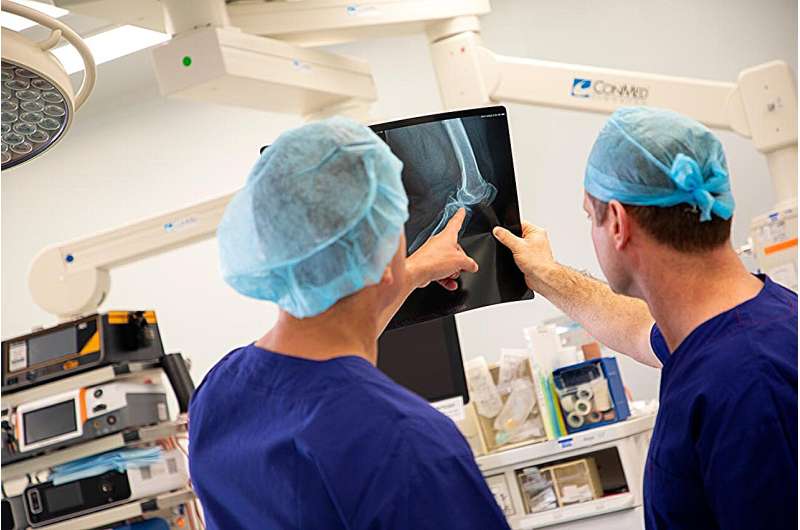
Surgeons looking at an X-ray image of a knee joint. Credit: CSIRO
Hip replacement surgery is one of Australia's most common orthopedic procedures, with demand rising as the population ages.
Yet regional patients continue to face persistent barriers to post-operative care: long travel distances for follow-up appointments, limited access to specialists, and uncertainty aboutrecoveryprogress.
The Fortius Institute for Musculoskeletal Research (FIMR), in partnership with Sunshine Coast Orthopaedic Group identified an opportunity to bridge this gap through the Panacea Pathway—a Concierge Service involving a digitally supported care pathway that delivers a surgeon-approved rapid recovery pathway delivered bynurse practitionersdirectly into patients' homes.
To bring this vision to life, FIMR partnered with the University of the Sunshine Coast to design a Nurse Concierge health care service for hip arthroplasty patients.
The program connects regional universities and small to medium enterprises to drive research partnerships across Queensland.
For the Sunshine Coast Orthopaedic Group, this partnership opened access to critical research expertise and data capabilities.
With support from the University of the Sunshine Coast, the team collected a more comprehensive dataset than would have been possible independently, laying the groundwork for training AI tools on real-worldclinical evidence.
The resulting clinical care pathway and at-home clinical care delivery integratespredictive analyticsand AI-driven insights to monitor patient progress remotely and identify risks early, reducing burden on patients while supporting better outcomes.
"Seeing our research directly improve patients' lives has been incredibly rewarding, and this project is demonstrating our approach is leading to safer, better and faster recovery for patients undergoing major orthopedic surgery," said Professor Nick Ralph from the University of Sunshine Coast.
"Working alongside clinicians through the RUIC partnership meant we could refine our data collection methods in real-time, building the robust dataset needed to develop an evidence-based care pathway."
The response to the at-home Nurse Concierge service has been overwhelmingly positive.
More than 3,000 at-home clinical appointments have been delivered, significantly reducing travel time and minimizing missed appointments.
Patients also reported greater confidence in their recovery, noting the reassurance and continuity of care provided by their Nurse Concierge.
"This project has demonstrated how remote care and digital health tools can reimagine the patient journey," said Dr. Stephanie Chaousis, Head of Digital Innovation at FIMR.
"By combining clinical expertise with data-driven insights, we're not just improving recovery outcomes—we're establishing a new standard for musculoskeletal care."
The data collected through the project has also provided valuable insights to further enhance care for joint replacement patients.
Building on the hip surgery pilot, the Sunshine Coast Orthopaedic Group plans to extend the pathway to knee replacement procedures.
This Panacea Pathway model has the potential to scale across hospital networks and inform clinical guidelines, expanding its benefits to more Australians through safer, more accessible recovery pathways.
Provided by CSIRO








Post comments