




































by Eva Maria Wellnitz
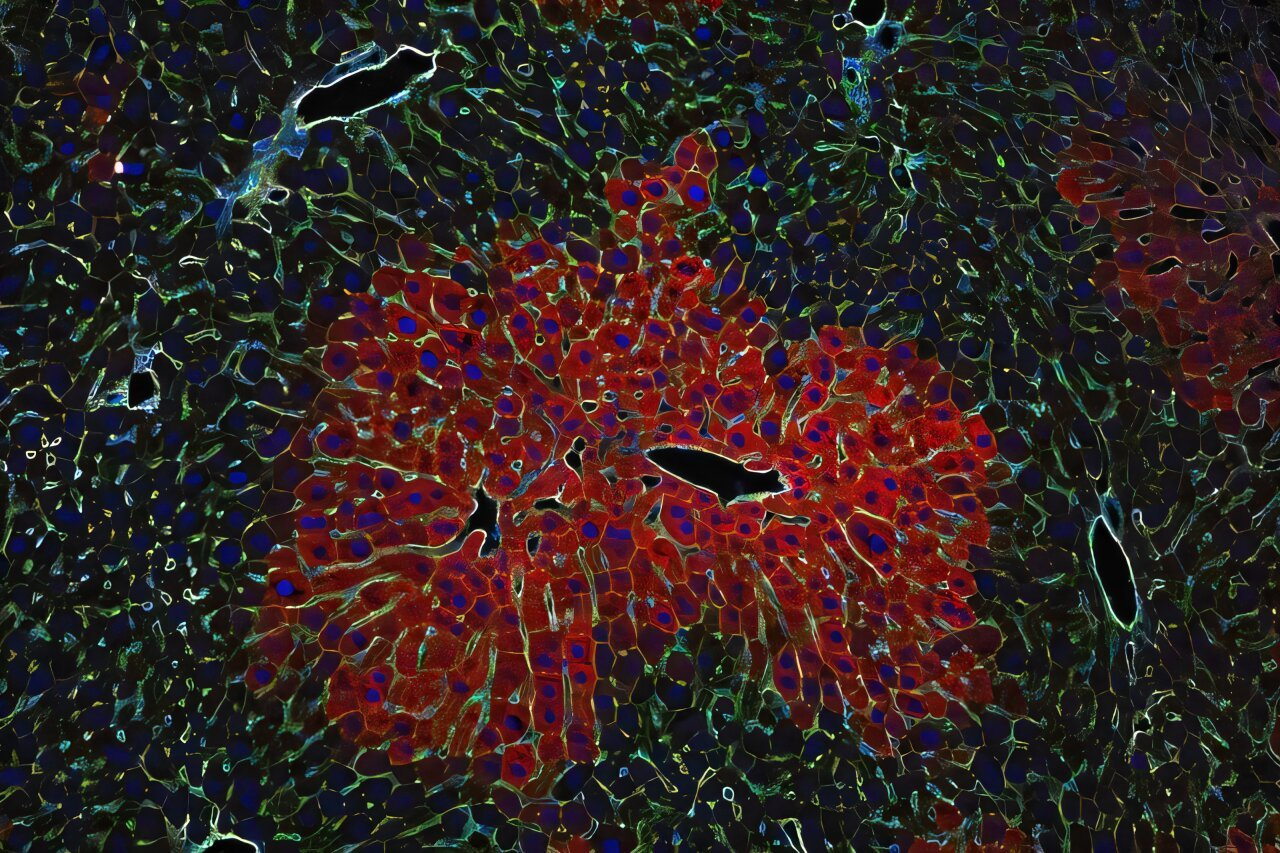
The cross-section shows the zoning of the liver, which allows the organ to organize its various functions spatially. Credit: Dr. Ki Hong Lee
The liver is organized into distinct zones in which liver cells perform different functions. The blood vessels of the liver play an important role in this spatial organization: the endothelial cells lining the vessels provide signals that instruct neighboring liver cells and help determine their function. But how do endothelial cells know which signals to produce?
Scientists from the Medical Faculty Mannheim of Heidelberg University and the German Cancer Research Center (DKFZ) have now identified a fundamental mechanism: blood flow and the biomechanical forces it generates determine which molecular program endothelial cells activate. Through the Wnt signaling pathway, they regulate the function of neighboring liver cells. The findings have been published in Nature Communications.
Distinct zones divide the liver's work
The liver performs a wide range of essential functions—from processing and storing nutrients to detoxifying the body and producing important blood proteins. Not all liver cells perform these tasks in the same way. Depending on where they are located within a liver lobule, different metabolic programs are active. This so-called metabolic zonation allows the liver to organize its different functions spatially.
The blood vessels of the liver play an important role in this spatial organization. Their endothelial cells, which line the smallest blood vessels—known as liver sinusoids—release so-called angiocrine signals to neighboring liver cells. In this way, endothelial cells can directly influence the function of the surrounding liver cells. Yet one fundamental question remained unanswered: How do endothelial cells know which signals to produce?
Blood flow becomes molecular instructions
The new study provides an unexpected answer: using genetically engineered mouse models, single-cell transcriptomics, spatial proteomics and biomechanical analyses, the researchers demonstrate that liver endothelial cells continuously monitor the physical forces generated by blood flow. Rather than oxygen or metabolic gradients, these hemodynamic forces establish distinct molecular programs within endothelial cells, enabling them to produce highly localized Wnt signals that instruct liver cell identity and metabolism.
"Our work changes the way we think about how blood vessels control organ function," says senior author Hellmut Augustin. "Blood vessels are not passive pipelines. They actively measure mechanical forces generated by blood flow and translate them into molecular instructions that organize the surrounding tissue."
The researchers further discovered that endothelial cells themselves are spatially organized to receive these signals. Wnt receptors are concentrated precisely where endothelial cells produce Wnt ligands, establishing localized signaling circuits that stabilize the molecular identity of different vascular niches.
"This shows that endothelial cells act like sophisticated biological interpreters," explains first author Dr. Ki Hong Lee. "They read physical information from blood flow and convert it into biochemical signals that tell neighboring liver cells which functions they should perform."
Vascular signals extend beyond liver cells
Beyond regulating hepatocytes, the biomechanical signaling program also shapes the endothelial cells themselves, influencing their morphology and the molecular connections they establish with neighboring vascular cells.
The findings provide one of the clearest mechanistic examples to date of how the microenvironment is translated into angiocrine signaling, a concept that is increasingly recognized across many organs, including the heart, lung, brain, kidney and bone.
Because disturbances of liver zonation contribute to chronic liver disease, fibrosis and liver cancer, understanding how vascular signaling is established may ultimately open new therapeutic opportunities. Rather than targeting liver cells directly, future therapies might aim to restore the instructive programs of the liver vasculature itself.
More information: Ki Hong Lee et al, Haemodynamic control of zonated liver function via instructive vascular Wnt signalling, Nature Communications (2026). DOI: 10.1038/s41467-026-76966-7
Provided by Universitätsmedizin Mannheim
Source: MedicalXpress
Original article: https://medicalxpress.com/news/2026-10-blood-assign-liver-cells-jobs.html








Post comments