



































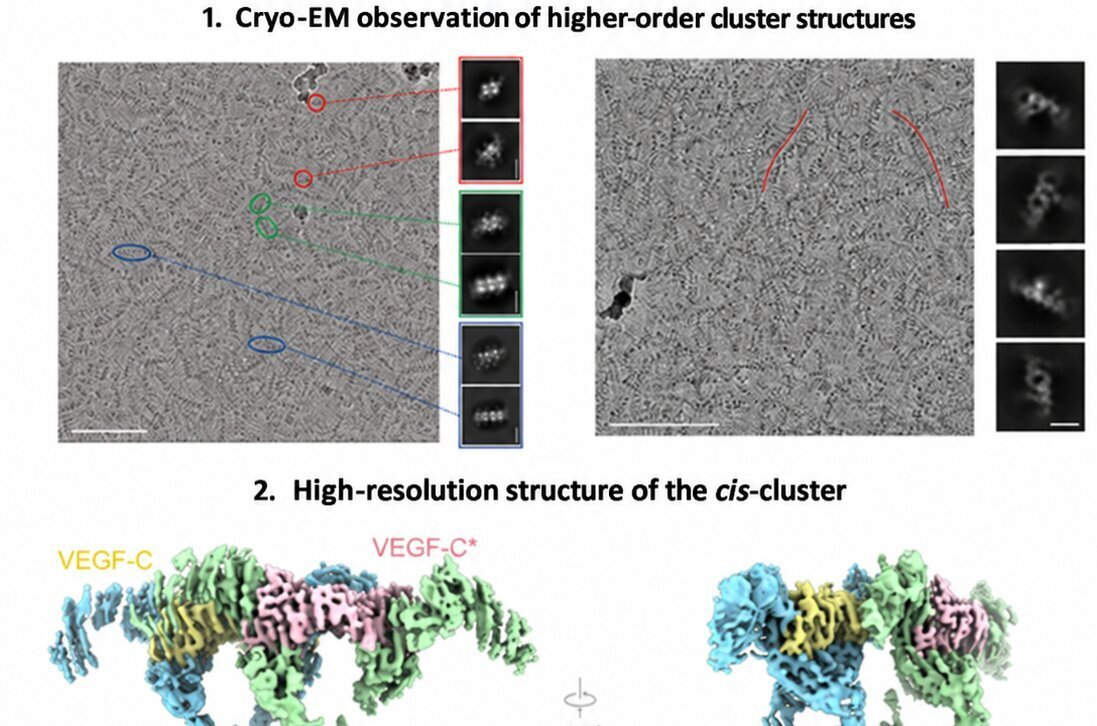
Cluster formation of the VEGFR-3/VEGF-C complex and signal amplification When VEGFR-3 was mutated to disrupt cis-cluster formation, the activation of VEGFR-3 and ERK was markedly reduced despite VEGF-C stimulation. This confirms that cis-clustering is critical for signal amplification. Credit: KAIST
Lymphatic vessels act as the body's "drainage system," collecting excess fluid from tissues. When lymphatic drainage is impaired because lymphatic vessels are underdeveloped, damaged or dysfunctional, lymphedema can develop, causing swelling, particularly in the arms and legs.
Conversely, excessive lymphatic vessel growth around tumors can facilitate cancer metastasis by providing routes for tumor cells to spread. Korean researchers have discovered that VEGF-C brings two VEGFR-3 receptors together, and the resulting VEGF-C–VEGFR-3 complexes further cluster to amplify signaling.
Targeting this clustering process may provide a new strategy for either enhancing or suppressing lymphangiogenic signaling, depending on the disease context.
Receptor clusters amplify lymphatic signaling
A joint research team led by professor Ho Min Kim from the Department of Biological Sciences at KAIST and Dr. Sangkyu Lee of the Institute for Basic Science (IBS) determined the three-dimensional structure of the VEGF-C–VEGFR-3 complex and identified how higher-order clustering of these complexes amplifies signaling. The findings are published in Advanced Science.
When VEGF-C binds to VEGFR-3 on the cell surface, the receptor is activated, and signals that regulate the formation and function of lymphatic vessels are transmitted into the cell. Until now, VEGF-C-mediated dimerization of two VEGFR-3 receptors has been considered a key step in receptor activation. However, how the signal becomes further amplified after this step has not been fully understood.
The research team examined the structure of VEGF-C bound to VEGFR-3 using cryogenic electron microscopy (cryo-EM), which enables detailed visualization of the three-dimensional structures of proteins.
They found that VEGF-C-induced complexes containing two VEGFR-3 receptors further assembled side by side into higher-order clusters. This revealed a new structural mode by which VEGF-C–VEGFR-3 complexes can organize laterally along the cell membrane.
Simply put, it is like two people first forming a team to begin a task, and then multiple teams gathering together to increase their collective strength.
The researchers also tested whether this clustering amplifies signaling. By altering the regions where the complexes contact one another and by using light to control receptor clustering, they confirmed that the gathering of multiple complexes plays an important role in signal amplification.
Therapeutic potential remains untested
This study identifies a new point at which lymphangiogenic signaling could potentially be regulated. In the future, researchers may explore ways to enhance signaling when lymphatic vessel formation is insufficient and to suppress signaling when excessive lymphatic vessels form around tumors.
However, this study did not demonstrate therapeutic effects for lymphedema or the inhibition of cancer metastasis, and further research will be required before the findings can be applied to treatments.
Kim said, "This study reveals how two VEGFR-3 receptors first form a ligand-induced pair, after which multiple such complexes cluster together to further amplify the signal for lymphangiogenesis," adding, "By identifying this previously unseen 'hidden amplification switch' in lymphangiogenic signaling, we expect this work to provide an important foundation for developing new therapeutic strategies for related diseases such as lymphedema and cancer metastasis."
Dr. Ryeongeun Cho of the KAIST InnoCORE AI-CRED Innovative Drug Research Group and Dr. Jinsook Ahn of the KAIST Department of Biological Sciences participated in the study as co-first authors. Kim of KAIST and Lee of IBS led the research as co-corresponding authors.
More information: Ryeongeun Cho et al, Structural Basis of Lymphangiogenic Receptor VEGFR‐3 Activation Mediated by Distinctive Clustering of the Ligand–Receptor Complex, Advanced Science (2026). DOI: 10.1002/advs.77728
Provided by The Korea Advanced Institute of Science and Technology (KAIST)
Source: MedicalXpress
Original article: https://medicalxpress.com/news/2026-10-hidden-lymphatic-amplifier-treatments-lymphedema.html






Post comments