




































byPaul Arnold, Medical Xpress
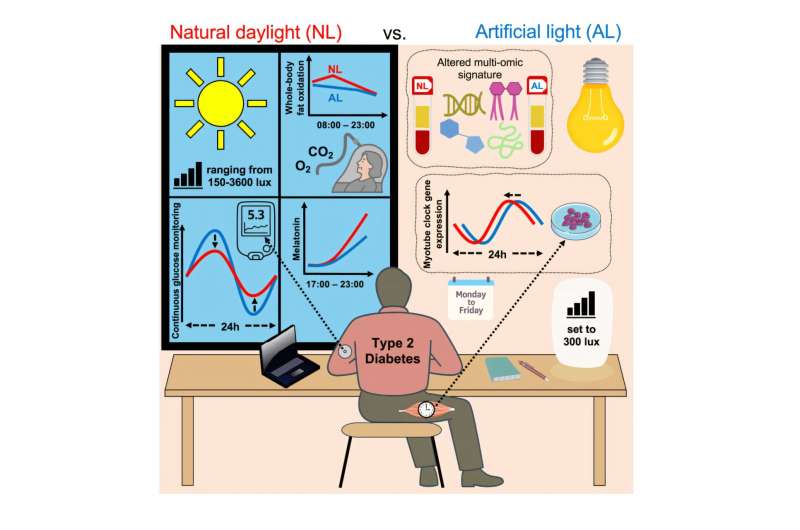
Graphical abstract. Credit:Cell Metabolism(2025). DOI: 10.1016/j.cmet.2025.11.006
People with type 2 diabetes may be able to improve their blood sugar by doing something as simple as sitting by a window for a few hours each day. In a studypublishedinCell Metabolism, scientists showed that natural daylight helps maintain healthy glucose levels.
Daylight is known to be a mood enhancer and also beneficial for our health. However, according to the research team, most people living in Western societies typically stay indoors around 80% to 90% of the time under artificial light, which is not as bright or dynamic as sunlight. This is important because the human body operates oncircadian rhythms, internal 24-hour clocks that orchestrate a range of biological processes, such as digestion and temperature regulation. These are synchronized by light, and a lack of natural light is a risk factor for type 2 diabetes.
Previous studies have shown thatartificial light at nightdisrupts these rhythms and that daylight outdoors can improve the body's response to insulin, which helps control blood sugar levels. But no prior research examined how natural light entering a window affects people with diabetes.
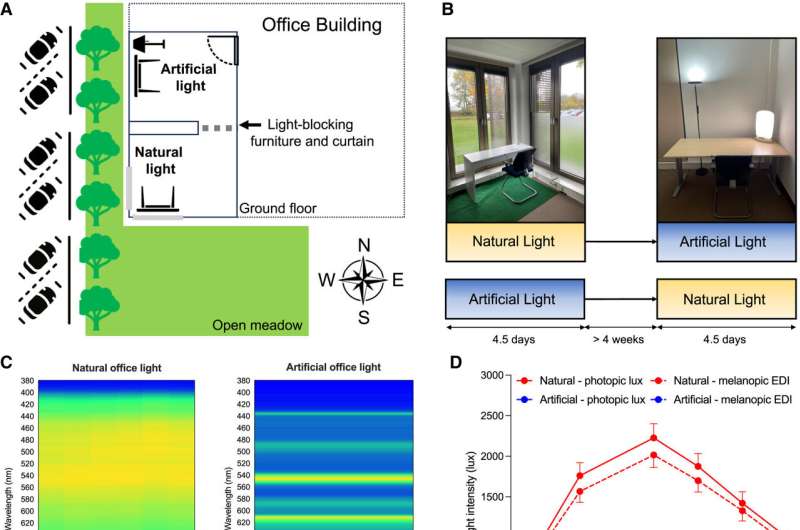
Study design and light condition characteristics. Credit:Cell Metabolism(2025). DOI: 10.1016/j.cmet.2025.11.006
To test this, the research team recruited 13 volunteers with type 2 diabetes to examine how their bodies responded to both natural window lighting and artificial indoor lighting. The participants spent two separate 4.5-day periods in a controlled office environment. In one session, they sat at a desk facing large windows from morning to late afternoon.
In the other, they were in the same room, with the windows blocked and only standard office lights. All participants ate similar meals three times a day and performed the same exercises at the same time across the two sessions. They also continued taking their medication.
The results revealed that while average glucose levels were similar across the two sessions, the participants spent significantly more time in the normal glucose range when exposed to natural daylight. The body's metabolism also changed. In daylight, the volunteersburned more fatfor energy and fewer carbohydrates.
The researchers also took muscle biopsies and grew muscle cells in the lab. They found that genes involved in their internal cellular clocks were better aligned to the time of day under natural light. This suggested that sunlight was acting as a signal to keep the muscles "on time," making them better at processing nutrients.
Although this study involved only a handful of people, the results indicate that natural daylight can help reduce the sharp peaks and swings in blood sugar that often affect those with this condition. It offers a simple, natural way to support people with type 2 diabetes alongside existing treatments.
"Our findings suggest that natural daylight exposure has a positive metabolic impact on individuals with type 2 diabetes and could support the treatment of metabolic diseases," note the researchers.
© 2025 Science X Network
More information Jan-Frieder Harmsen et al, Natural daylight during office hours improves glucose control and whole-body substrate metabolism, Cell Metabolism (2025). DOI: 10.1016/j.cmet.2025.11.006 Journal information: Cell Metabolism










Post comments