



































by Kim North Shine,University of Michigan
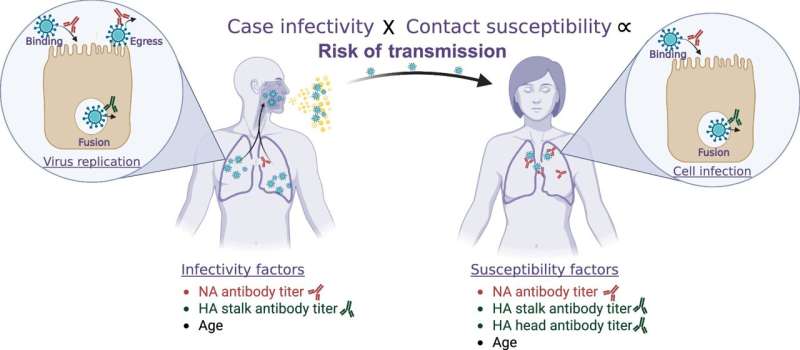
Factors influencing pairwise transmission risk, as tested across the different models used in the study. Credit:Nature Communications(2025). DOI: 10.1038/s41467-025-65283-0
Today's influenza vaccines primarily prevent infection in individuals, but new research led by the University of Michigan and the Institut Pasteur suggests that incorporating antibodies generated after infection could lead to more powerful vaccines by also reducing person-to-person transmission.
Future vaccines that boost the antibodies—neuraminidase, or NA, in particular, along with, HA head and HA stalk (HA stands for hemagglutinin)—may add an important layer of community protection, the researchers say.
"NA is a part of the influenza virus that has been relatively overlooked in vaccine design, yet they play a key role not only in lowering infection risk but also in reducing how contagious someone becomes when infected," said Aubree Gordon, co-senior study author and director of the Michigan Center for Infectious Disease Threats and Pandemic Preparedness.
The study ispublishedin the journalNature Communications. It comes amid warnings of a severe flu season ahead and as the first deaths of the 2025–2026 flu season are being recorded in the Northern Hemisphere. Influenza infects upwards of 1 billion people and leads to some 650,000 deaths globally each year. Lost productivity and hospitalizations due to the flu also result in major economic loss and burden.
"Modifying vaccines to includeNA antibodiesprovides an extra layer of defense that's especially important for infants, immunocompromised individuals and others who can't mount strong vaccine responses," Gordon, an epidemiologist from the School of Public Health said. "This could also be very important if we were to have an influenza pandemic."
She helped lead a multinational research team that followed 171 Nicaraguan households and their 664 contacts over three influenza seasons—2014, 2016, 2017. Almost all of the participants had never been vaccinated, allowing researchers to observe transmission patterns driven primarily by antibodies from infection.
Through bloodwork, virologic testing and the power of mathematical modeling, the researchers identified which antibodies were most effective at limiting spread.
Simon Cauchemez, epidemiologist and infectious disease modeler from Institut Pasteur and its Mathematical Modeling of Infectious Diseases Unit, is senior co-author with Gordon and said the detailed household data and modeling methods let the researchers chart and document how the antibodies reacted and which were most powerful in keeping an infected person from spreading the flu to people they came into contact with.
"Understanding which factors drive thespread of influenzais essential to designing more effective control strategies but is often challenging. Here, we were able to obtain such insight thanks to the analysis of very detailed data documenting influenza transmission in households with state-of-the-art modeling techniques," Cauchemez said.
Very few people in the study were vaccinated, giving the researchers the opportunity to watch how immunity, primarily from prior infection, impacts the chances you'll get influenza and whether you spread it to others. It's an important distinction, because people who get influenza can bestrongly protectedagainst that same type of influenza for many years, while vaccines for influenza tend to provide moderate protection for less than a year.
"By studying immunity after infection," the authors wrote, "we can identify which antibody responses are most protective and translate those insights into improved vaccine designs that provide stronger and longer-lasting protection."
More information Gregory Hoy et al, Anti-neuraminidase and anti-HA stalk antibodies reduce the susceptibility to and infectivity of influenza A/H3N2 virus, Nature Communications (2025). DOI: 10.1038/s41467-025-65283-0 Journal information: Nature Communications








Post comments