




































by Melissa J. Perry,George Mason University
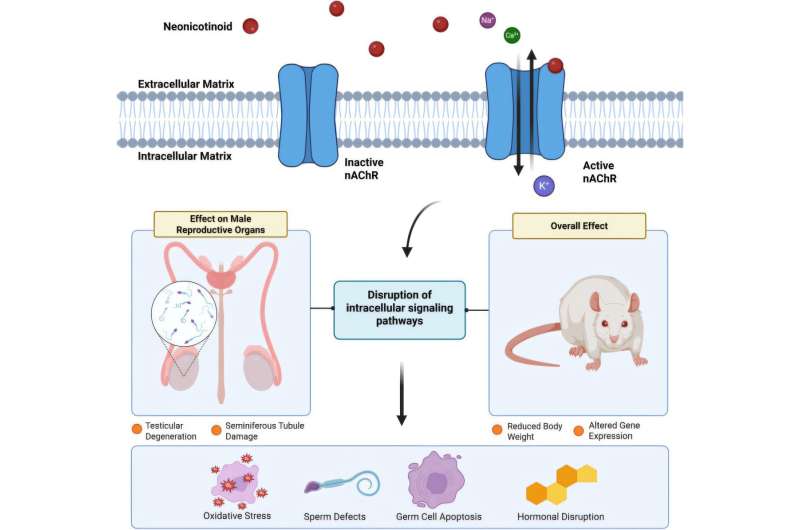
Graphical overview of potential neonicotinoid mechanism of action. Neonicotinoids (red circles) act as agonists by binding to nicotinic acetylcholine receptors (nAChRs), causing prolonged receptor activation. Credit:Environmental Research(2025). DOI: 10.1016/j.envres.2025.122903
Contemporary agricultural practices make it difficult to prevent consuming chemicals and potentially causing harm to the body.
In collaboration with faculty in the colleges of public health and science, George Mason University College of Public Health alumna Sumaiya Safia Irfan and College of Science student Veronica Sanchez reviewed 21 experimental studies that took place from 2005 through 2025, which consistently indicate that insecticide exposure may negatively affect human health, specifically male reproductive health.
"We concluded it is possible that exposure to these chemicals can lower sperm quality, disrupt hormones, and damage testicular tissue," said Irfan, first author and master of public health in epidemiology from George Mason.
The study,"Reproductive risk of Neonicotinoids: A review of male rodent studies,"is published in theJournal of Environmental Research.
Neonicotinoid pesticides (neonics) are the most widely used insecticides in the world, and very commonly used in farming. When sprayed on crops, they are absorbed into the soil, water, and plants, which then may be consumed by humans. To determine the potential risk to humans, Irfan and Sanchez looked at how neonics affect male reproductive health in rodents.
"Many individuals may not realize that insecticide residue found on food could be a contributing factor to infertility. All studies included in this review reported that neonicotinoid exposure was harmful tosperm qualityin the male rats and mice," said Sanchez, a master of science in chemistry student and a full-time research assistant at the George Mason Center for Applied Proteomics and Molecular Medicine.
Impacts on human reproductive systems remain largely unknown, but this study offers sufficient cause for further investigation.
"These findings warrant pause for reflection, as the extent of the effect of neonics on human health is not yet fully understood," said Sanchez, who is expected to graduate fall 2025. "There needs to be further research into the effects of neonics on humans so we can begin to discuss mitigation strategies."
Insight from Dean of the College of Public Health and renowned environmental health epidemiologist Melissa Perry, also a contributing author, substantiates the results.
"Neonicotinoid insecticide use in U.S. agriculture has grown significantly over the last decade, so we know that exposures happen routinely for a large number of people. We need to conclusively determine how this affects members of the American public," said Perry.
The U.S. Food & Drug Administration offersseven tips for cleaning fruits and vegetablesto protect families from dirt, lingering preservatives, and other remnants from the agricultural process that can cause illness. While this can remove surface contaminants, pesticides used in farming are not so easy to get rid of.
With this in mind, Irfan shares whether there is a way to reduce neonic exposure. "In general, you can reduce pesticide exposure by thoroughly washing produce before eating and by minimizing conditions that attract pests into your home that would require you to use some form of pest control," she said.
"However, because neonicotinoids are often applied systemically, meaning they are absorbed by the plant and present throughout its tissues, they are very difficult if not impossible to remove completely. The best way is to be aware of what you are buying and shop responsibly."
More information: Sumaiya S. Irfan et al, Reproductive risk of Neonicotinoids: A review of male rodent studies, Environmental Research (2025). DOI: 10.1016/j.envres.2025.122903 Journal information: Environmental Research
Provided by George Mason University









Post comments