




































by Shivani Pasricha,University of Melbourne
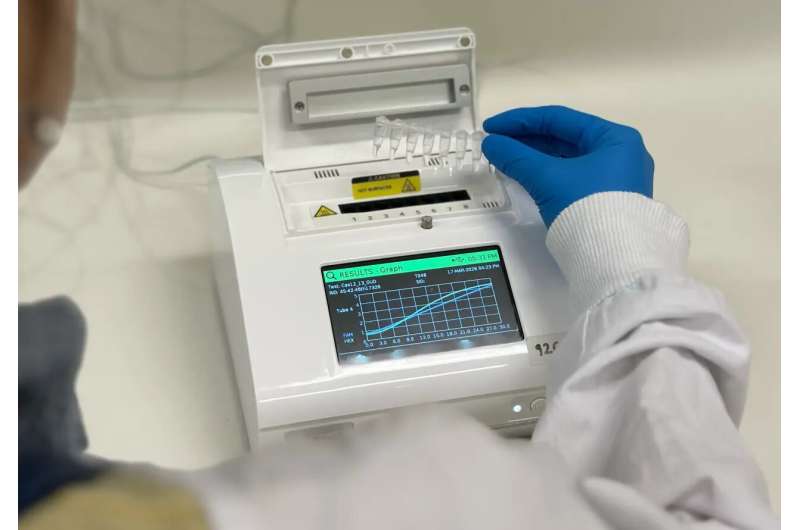
With STIs on the rise, this new test arrives at a critical moment. Credit: Anthea Jessica Himawan Hardosubroto and Dheeraj Nurani Venkatachalam/Doherty Institute
Most people who have heard of clustered regularly interspaced short palindromic repeats (more commonly known asCRISPR) associate it with gene editing—the precise molecular scissors that allow scientists to cut and rewrite DNA. But the same underlying technology that makes CRISPR so powerful for editing genes also makes it a versatile diagnostic tool.
Our team of researchers at the Doherty Institute have now put that versatility to work in a new device: theworld's first rapid, point-of-care testcapable of detecting all major bacterial sexually transmitted infections (STIs)—including syphilis—on a single platform in under an hour.
CRISPR-Cas as a diagnostic tool
The new test is built onCRISPR-Cas—specifically, theCas enzyme systemthat underpins the gene-editing tools. But in diagnostics, the goal is detection rather than modification.
The diagnostic test works in two stages.
First, any target genetic material present in the sample, like urine or a genital swab, is amplified at a single, steady warm temperature so that even small amounts of pathogen can be detected.
This step, known asisothermal amplification, avoids the need for sophisticated thermal cycling equipment in a traditional lab, likepolymerase chain reaction(PCR) machines, which are commonly used to amplify segments of DNA.
This makes it far more suitable for a clinic setting.
Then comes CRISPR.
The CRISPR-Cas system consists of two components that bind together: a Cas enzyme and a guide RNA molecule—think of it as a molecular postal address label—that has been programmed to recognize the genetic sequence of a specific pathogen.
If that pathogen is present in the sample, the guide molecule locks on and this turns the Cas enzyme on, which cuts the target DNA orRNA.
Importantly, now the Cas enzyme stays on and can cut up nearby introduced reporter molecules (which detect any activity) producing a signal the instrument can read.
Because the device can runmultiple Cas enzymesand guide molecules simultaneously, it can screen for several different infections at once.
The tech then reports which infections are present—all from the same sample. In the case of STIs, this means doctors don't have to choose between testing for herpes or syphilis.
This is substantially different to our current approach that requires two very different types of tests and relies on intravenous blood collection for syphilis and a swab sample for herpes.
Access to testing can be limited, especially in rural and remote areas where samples may have to travel long distances and laboratory turnaround times are slow.
Even in busy urban clinics, STI testing often involves multiple visits, sometimes making it difficult for people to return for results and treatment.
And withSTIs on the rise, this new test arrives at a critical moment.
STIs are on the rise
In August 2025,Australia's Chief Medical Officer declared syphilis a Communicable Disease Incident of National Significance—a formal recognition that infections have climbed and control efforts need to be strengthened.
National surveillance also told us thatinfectious syphilis diagnoses have more than doubled in the past decade: 6000 cases in 2024 alone.
Syphilis is a bacterial infection transmitted primarily through sexual contact.
It initially presents as a genital ulcer within days to weeks of exposure and, if untreated, progresses to highly infectious stages causing ongoing transmission, with infection then spreading through the bloodstream to invade tissues.
While case numbers arehigher in men who have sex with men, there is a rise in heterosexuals, including women of reproductive age.
The health consequences for this group can include infertility, miscarriages and congenital syphilis, where babies are born with serious complications due to maternal infection.
So, a fast diagnosis can be vital.
The new device is designed to collapse this process into a single appointment. A person could provide a sample, have it tested on the device and receive both a diagnosis and a treatment plan before leaving the clinic.
Detecting antibiotic resistance
Our new tool also does more than detect which infections are present.
We can detect pathogen DNA and RNA—the genetic instructions that allow germs like bacteria and viruses to replicate, survive and cause disease.
But it is also configured to look for a genetic marker ofantibiotic resistancein gonorrhea—one of the most treatment-resistant of the common bacterial STIs.
That information can help clinicians choose an effective antibiotic much faster, rather than prescribing empirically and waiting to see if treatment works.
Asresistance to standard gonorrhea treatments grows globally, this kind of targeted prescribing information is increasingly valuable.
This resistance detection capability is something that is unique to our new tool.
CRISPR diagnostics beyond STIs
In the future, our new platform also has the potential to help withself-collected samples.
While there's still some work to do, this could extend access to STI screening for people who face barriers to in-person care or who prefer not to come to a clinic.
Of course, new technology is only one part of the solution.
Continued emphasis on clinician education, culturally safe care and equitable access to sexual health services remains essential.
While our technology doesn't replace human and structural dimensions of patient care, it does make it easier to test for several infections at once, and potentially do so closer to where people live and seek care.
Our portable CRISPR‑based tests add a practical tool to the broader effort to improve STI detection and management across Australia.
This article was first published on Pursuit. Read the original articlehere.
Key medical concepts Sexually Transmitted Infections Syphilis







Post comments