




































byUniversity of Texas Health Science Center at Houston
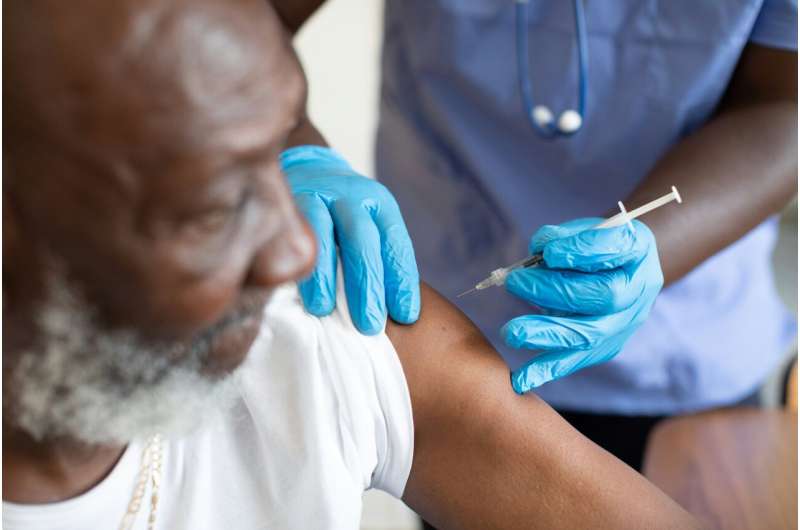
Credit: Unsplash/CC0 Public Domain
The risk of Alzheimer's disease significantly decreases in older adults who receive a higher dose of the influenza vaccine compared to the standard dose, according to new research led by UTHealth Houston. The findings arepublishedinNeurology.
Alzheimer's disease is the most common form of dementia, affecting more than 7 million Americans ages 65 and older as of 2025, which is roughly one in nine people in that age group. That number is expected to more than double by 2050.
A 2022studyled by Paul Schulz, MD, professor of neurology at McGovern Medical School at UTHealth Houston and director of the Neurocognitive Disorders Center at UTHealth Houston Neurosciences, found that the risk of Alzheimer's disease for a person 65 years and older was reduced if they received the influenza vaccine.
Now, just three years later, Schulz and his team have published another study showing the risk of Alzheimer's disease was significantly decreased in older adults who received a higher dose of the influenza vaccine.
How questions about dose emerged
"The public health department had seen our vaccine research and asked if I could come down to talk to them about it," said Schulz, who is the senior author of the study and the Rick McCord Professor in Neurology and Umphrey Family Professor in Neurodegenerative Diseases at McGovern Medical School. "We went through the findings, and they asked if there was a difference with different dosages; I was confused."
At age 65, the immune system becomes less effective at fighting infection. TheCDCrecommends that adults 65 and older receive a high-dose flu vaccine, four times stronger than the standard dose given to the general population.
"I was stunned that as a physician, I didn't know a higher dose was offered," Schulz said.
Flu shot guidance for older adults
Receiving the flu vaccine is recommended for all populations, but complications from the flu infection can be especially detrimental in someone with Alzheimer's disease. Before 2022, the CDC didn't recommend one intramuscular flu vaccine type over another for adults aged 65 and older; the guidance was simply that an annual flu vaccination should be administered, regardless of formulation.
While prior UTHealth Houston studies showedinactivated flu vaccinesare associated with a 40% reduced risk of developing Alzheimer's disease, there was no research on how much risk might be reduced by getting a higher dose of the vaccine.
Schulz also learned that because the senior population is growing and in some areas outnumbers the supply of high-dose vaccines, some older adults end up receiving the standard dose instead.
New study tracks thousands of seniors
"So we started looking, and sure enough, we were able to put together thousands and thousands of people over the age of 65 who got thehigh- or low-dose vaccine. They're more at risk for Alzheimer's than anybody else, of course, because it's age-related and we could look at high-dose versus low-dose and see if there was a difference," Schulz said.
The researchers analyzed nearly 200,000 participants ages 65 and older, both men and women, and found that high-dose influenza vaccination was associated with a reduced risk of Alzheimer's disease compared with standard-dose vaccination. The results also showed that the protective effect of the high dose was stronger among women.
They found that in comparison to the standard-dose flu vaccine—which reduced risk of Alzheimer's disease by 40%—those 65 years and older who received the high-dose flu vaccine had a nearly 55% reduced risk of developing Alzheimer's disease.
Avram Samuel Bukhbinder, MD, a McGovern Medical School alumni who is now a clinical fellow in neurology at Massachusetts General Hospital and Harvard University, is a corresponding author. Schulz is also a faculty member of The University of Texas MD Anderson Cancer Center UTHealth Houston Graduate School of Biomedical Sciences.
Publication details Avram Samuel Bukhbinder et al, Risk of Alzheimer Dementia After High-Dose vs Standard-Dose Influenza Vaccination, Neurology (2026). DOI: 10.1212/WNL.0000000000214782 Journal information: Neurology










Post comments