



































by Roni Dengler,Thomas Jefferson University
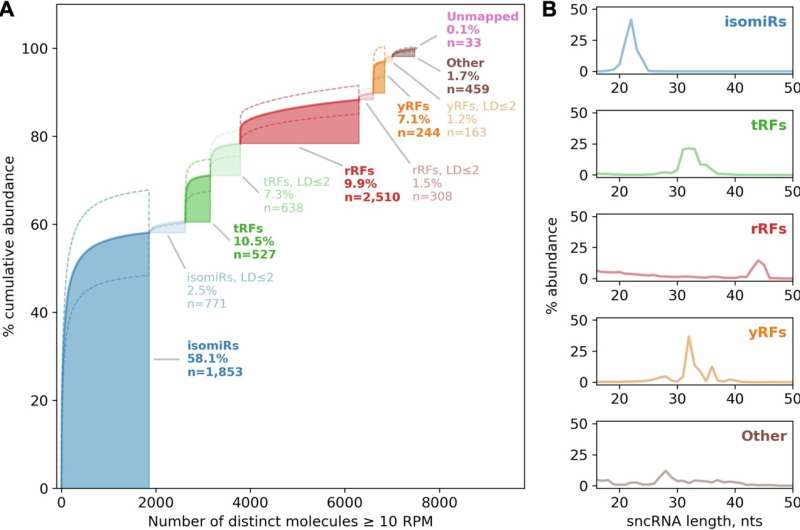
The abundance of sncRNAs in the analyzed brain samples.AWithin each molecule type, sncRNAs are ranked by mean RPM across 170 samples (rank is captured by increasing X values), whereas the cumulative mean (solid line) ± standard deviation (dashed line) are shown on the Y-axis. “Other” molecules include rpFs (see Methods).BHistograms of sncRNA lengths for each molecule type (% values sum up to 100% within each molecule type). IsomiRs, tRFs, rRFs, and yRFs include wild-type and LD ≤ 2 sncRNAs. Credit:Translational Psychiatry(2026). DOI: 10.1038/s41398-026-03808-x
For decades, scientists studying brain disorders have focused almost exclusively on proteins and the genes encoding them. Now, research from Thomas Jefferson University's Computational Medicine Center suggests that several classes of small regulatory molecules, fittingly known as small RNAs, may play a much larger role in schizophrenia and bipolar disorder, and in a healthy brain, than previously thought.
In a study recentlypublishedinTranslational Psychiatry, a team led by Isidore Rigoutsos, Ph.D. took a comprehensive look at small RNAs in brain samples from people with schizophrenia, bipolar disorder and individuals without psychiatric illness. Their goal was to find out what kind of small RNAs are active in the brain, and whether their levels change in disease.
"Little attention had been paid to small RNAs in these disorders," says Dr. Rigoutsos, "even though small RNAs help control numerous processes by modulating the abundance of genes."
One well-known group, called microRNAs, had been studied but not extensively.
"If you only look at one class, you may be missing important regulatory events," adds Dr. Rigoutsos.
To capture the broader picture, researchers useddeep sequencingand specialized computational tools developed in the Rigoutsos lab. This allowed them to analyze multiple classes of small RNAs at once, and they found that microRNAs account for just over half of all small RNAs in the brain. The remainder comes from theother classesthe Rigoutsos team studies. The team found that these other RNAs may regulate critical processes in schizophrenia and bipolar disorder, as well as in healthy brains.
Also, a surprising pattern emerged when the team separated participants by age. The small RNA profiles of young patients looked substantially different than those of healthy, young people. Yet, those differences disappeared when the researchers compared the profiles from the brains of older patients with those from older individuals without mental illness.
"It turns out that the differences in the small RNA populations happen early on in patients' lives," Dr. Rigoutsos says.
The findings highlight the growing importance ofdata-driven, collaborative science.
"To understand complex disease," Dr. Rigoutsos continues, "we need to study all the molecules that are present and work across disciplines."
Publication details Stepan Nersisyan et al, Several novel classes of small regulatory RNAs show widespread changes in schizophrenia and bipolar disorder and extensive linkages to critical brain processes, Translational Psychiatry (2026). DOI: 10.1038/s41398-026-03808-x Journal information: Translational Psychiatry











Post comments