




































by Marie-Josette de Medeiros and Caroline Devillers,University of Montreal
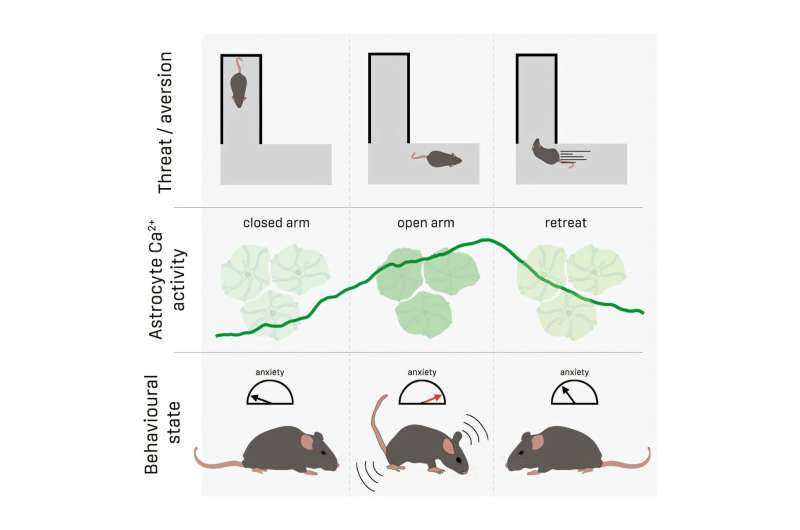
Graphical abstract. Credit:Neuron(2026). DOI: 10.1016/j.neuron.2026.02.038
In a study published inNeuron, Ciaran Murphy-Royal, researcher at the Center de recherche du Center hospitalier de l'Université de Montréal (CRCHUM), and his team show that astrocyte activity in the brain's fear center, the basolateral amygdala, is not merely a reflection of neuronal activity. They explore the role of astrocytes in assessing threats and anxiety, and challenge the notion that astrocytes are nothing more than support cells.
This project, which initially focused on fear learning, took a new direction when the team observed a marked increase in calcium activity in the astrocytes of the basolateral amygdala in mice when humans approached them. Intrigued by this signal, which differs from classical neural communication, they decided to investigate its connection to anxiety.
Astrocytes: On the lookout for danger
After using the elevated plus maze—certain sections of which are difficult for mice to interpret—the team opted for a successive alleys test, which offers a linear progression toward increasingly aversive compartments. In this test, astrocyte calcium activity gradually increased as the rodents moved forward, reflecting their growing perception of the threat.
"Some didn't get very far, others stopped halfway, and others made it all the way to the end," explained Ciaran Murphy-Royal, also an assistant professor in the Department of Neuroscience at the Faculty of Medicine at University of Montreal.
"Themost anxious micereach their maximum activity level much sooner, and as soon as they do, they stop exploring. In fact, these mice exhibit consistently high levels of anxiety in various tests, which corresponds to what is known in humans as trait anxiety."
The team then studied how the brain reacts when a new element is introduced into an environment that has become familiar. The astrocytes adapted very quickly.
After a single exploration, the warning signal disappears as soon as the environment is no longer perceived as threatening, suggesting that astrocytes are fast and dynamic. In the basolateral amygdala, their anxiety-related calcium activity proved to be more precise than that of the neurons, despite the neurons being highly active.
They then used this signal totrain a decodercapable of determining whether a mouse was in an anxiogenic area. Notably, the astrocyte signal outperformed neuronal signals in predicting the mice's location in another maze.
By directly manipulating astrocyte calcium activity, Murphy-Royal's team demonstrated a causal relationship: when calcium levels were increased, the mice exhibited markedly more anxious behavior.
The alarm signal: Norepinephrine
Astrocytes, which possess a wide variety of receptors and are located near blood vessels and neurons, are responsive to a wide range of hormones and neurotransmitters. This new study shows that norepinephrine—both a neurotransmitter and hormone released in response to stress—is the alarm signal that triggers these robust changes in astrocyte activity.
"According to our data, it appears that the signal actually originates elsewhere, in thelocus coeruleus," explains Mathias Guayasamin, co-first author of the study. "This region releases norepinephrine and projects it to the amygdala." Once theadrenergic receptorwas removed from the astrocytes, the mice were more likely to explore the anxiogenic environment.
"This discovery adds another layer of complexity," says Murphy-Royal. "Instead of being driven solely by neuron-to-neuron communication, astrocytes are also recruited by signals from another region of the brain."
This study therefore demonstrates that astrocyte activity actually encodes relevant information and shifts the focus to these cells in the study of anxiety.
By proving that astrocytes are the orchestrators of anxiety, this study opens promising avenues for this field of research and could help in the development of treatments for disorders such as generalized anxiety disorder.
Publication details Ossama Ghenissa et al, Basolateral amygdala astrocytes encode anxiety states, Neuron (2026). DOI: 10.1016/j.neuron.2026.02.038 . www.cell.com/neuron/fulltext/S0896-6273(26)00163-7 Journal information: Neuron









Post comments