




































byUniversity of Pennsylvania
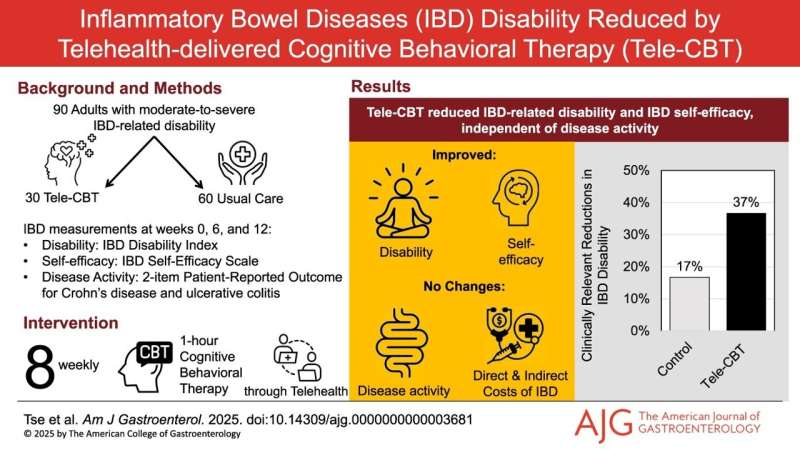
Credit:American Journal of Gastroenterology(2025). DOI: 10.14309/ajg.0000000000003681
Psychologist Melissa Hunt and gastroenterologist Chung Sang Tse and colleagues have found that cognitive behavioral therapy reduced disability for patients with Crohn's disease and ulcerative colitis and that psychologists with no prior gastrointestinal experience could learn to deliver this therapy effectively.
This time of year is stressful for many people, but it can be particularly challenging for those with gastrointestinal issues, as concerns about food triggers and bathroom accessibility can heighten anxiety.
People with inflammatory bowel diseases (IBD), such as Crohn's disease and ulcerative colitis, frequently experience not only physical symptoms—such as diarrhea, pain, and fissures or fistulas—but also the psychological burden of living with a chronic disease, says Perelman School of Medicine gastroenterologist Chung Sang Tse. Inflammatory symptoms can exacerbate psychological distress, causing anxiety, depression, agoraphobia, and PTSD, which in turn can trigger physical symptoms.
Melissa Hunt, associate director of clinical training in Penn's Department of Psychology, says people with gastrointestinal disorders may be too embarrassed to tell even close loved ones what they're going through.
Penn Today spoke with Tse and Hunt about their research on the use of cognitive behavioral therapy (CBT)—a psychotherapy that targets inaccurate thoughts and maladaptive behaviors—to reduce IBD-related disability.
In arandomized controlled trial, Tse and Hunt found that IBD patients who underwent eight weeks of IBD-informed CBT through telehealth had significantly lower IBD-related disability. Their findings, which build on Hunt's self-help book on CBT for IBD, arepublished in TheAmerican Journal of Gastroenterology.
IBD-related disabilityrefers to restrictions in work, school, or leisure activities or the inability to do activities at all, Tse explains, and up to half of adults with IBD experience moderate-to-severe IBD-related disability.
Hunt trained five clinical psychologists at Penn's Center for the Treatment and Study of Anxiety to deliver CBT for IBD through teletherapy, which the psychologists provided to urban and rural patients in Philadelphia, Tennessee, Arizona, Wisconsin, and Rhode Island. The training was completed with a manual that Hunt wrote, which includes a primer on IBD, an overview of psychiatric comorbidities with IBD, treatment approaches, and case studies.
Hunt says one example of a treatment approach would be to have patients go into stores with no public restroom and ask something like, "I'm so sorry, this is a medical emergency. Can I please use your restroom?" Such exercises in exposure therapy, Hunt says, can help people build confidence.
In apaper published inBehaviour Research and Therapy, Hunt and Tse show that CBT-trained clinical psychologists with no prior IBD experience could adhere to the IBD-CBT manual and deliver therapy well, and that fidelity to teaching deep diaphragmatic breathing was associated with greater reductions in disability.
Deep diaphragmatic breathingis a relaxation technique that Hunt says engages the parasympathetic nervous system and improves digestion. "It can actually reduce cramping and urgency, which increases people's confidence about their ability to go out and about in the world," she says.
Hunt is building off this work by supervising a new gastrointestinal psychology rotation as part of the Clinical Psychology Internship Training Program, housed in the Department of Psychiatry in Penn Medicine. The rotation, which will educate clinical psychology Ph.D. trainees on helping patients with both IBD and irritable bowel syndrome (IBS), is getting its first intern in January.
Hunt says that unlike IBD, IBS is a disorder of gut-brain interaction and does not respond well to traditional medical management, so she argues that psychotherapy should be the frontline treatment for most IBS patients. Referrals for the intern will come through Penn Medicine's Division of Gastroenterology.
"The goal is to start to show proof of concept in gastroenterology that for particular folks with irritable bowel syndrome, we may be able to substantially reduce medical utilization and allow the gastroenterologists to spend more time with the patients—like IBD patients—who need pharmacological and surgical management," Hunt says.
More information Chung Sang Tse et al, Inflammatory Bowel Diseases-Specific Cognitive Behavioral Therapy Delivered Through Telehealth Reduces Disability: Addressing Disability Effectively With Psychosocial Telemedicine Pragmatic Randomized Controlled Trial, American Journal of Gastroenterology (2025). DOI: 10.14309/ajg.0000000000003681 Melissa Hunt et al, Psychotherapy process variables in implementation of CBT for inflammatory bowel disease:Therapist competence, fidelity, and patient themes, Behaviour Research and Therapy (2025). DOI: 10.1016/j.brat.2025.104702 Journal information: American Journal of Gastroenterology










Post comments