




































by JMIR Publications
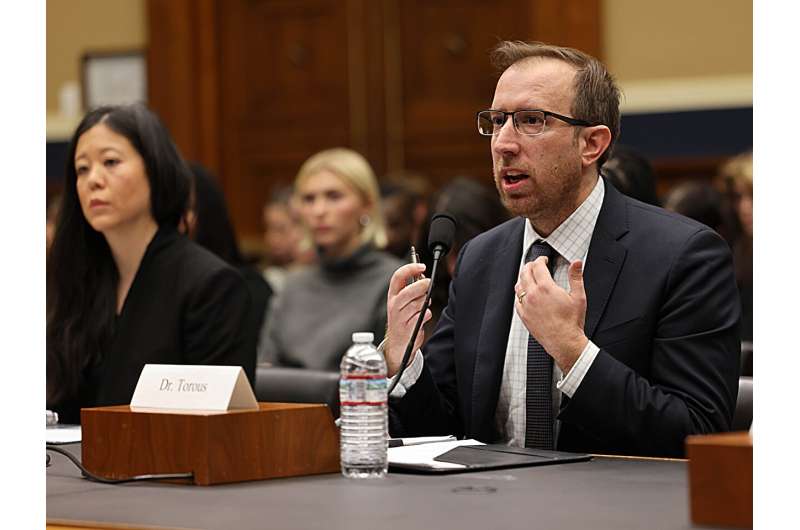
John Torous, MD, MBI, providing expert testimony at the United States House Energy and Commerce Committee hearing on the risks and benefits of chatbots. Credit: John Torous
A new analysis examines a potential turning point for artificial intelligence in mental health care. The article,"Feasible but Fragile": An Inflection Point for Artificial Intelligence in Mental Health Care,reflects on the November 18, 2025 United States House Energy and Commerce Subcommittee hearing on AI chatbots and features an interview with John Torous, MBI, MD, Director of Digital Psychiatry at Beth Israel Deaconess Medical Center and Associate Professor of Psychiatry at Harvard Medical School.
Dr. Torous, who provided expert testimony at the hearing, describes it as a rare early instance of congressional oversight in digital mental health and sees it as signaling the end of "AI exceptionalism"—treating AI tools as unique and therefore outside the standards applied to other clinical innovations. He emphasizes that whether AI fulfills its promise in mental health will depend on decisions made now about oversight, research, and patient safety.
The article highlights Dr. Torous's concern that much of the current AI landscape measures success byuser engagementrather than safety or efficacy. Drawing on lessons from mental health apps, he warns that focusing on engagement alone is a "race to the bottom" that neither improves safety nor effectiveness.
To address this, Dr. Torous identifies three essential shifts:
Dr. Torous sees significant positive potential for AI tools. By integratingpersonalized data—including physiological, environmental, and emotional information—AI could generate new insights and approaches to mental health care. Provided safety risks are mitigated, AI has the potential to help us move beyond merely replicating existing treatments to a new era of "personalized insights" that could redefine mental health nosologies and create entirely new therapeutic models.
He stresses that this future is "feasible but fragile," dependent on trust, oversight, and collaboration among clinicians, patients, researchers, regulators, and developers.
The paper is published in theJournal of Medical Internet Research.
More information Kayleigh-Ann Clegg, "Feasible but Fragile": An Inflection Point for Artificial Intelligence in Mental Health Care, Journal of Medical Internet Research (2025). DOI: 10.2196/89202 Journal information: Journal of Medical Internet Research









Post comments