




































by Ark Surgical Ltd.
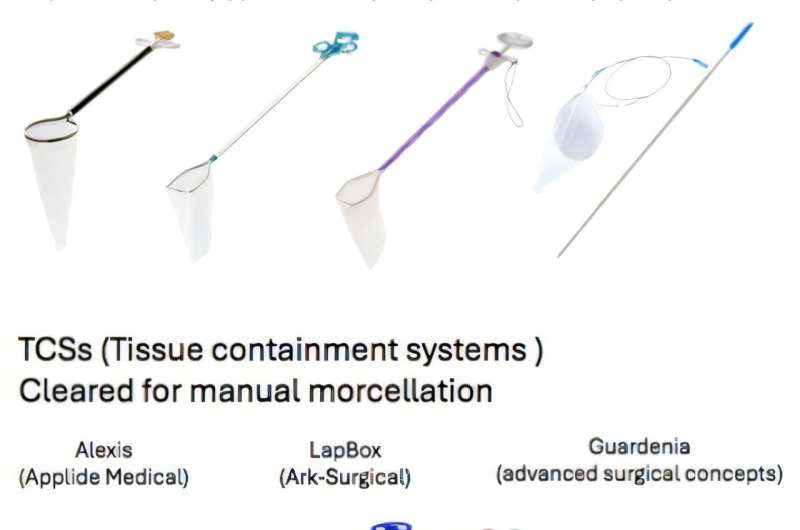
FDA Cleared Tissue Retrieval Bags and Tissue Containment Systems. Credit:Gynecology & Reproductive Health(2025). DOI: 10.33425/2639-9342.1284
A newnational survey of first-year fellows in minimally invasive gynecologic surgery(FMIGS) has revealed significant gaps in the use of FDA-cleared containment systems during laparoscopic hysterectomy and myomectomy. The work is published inGynecology & Reproductive Health.
In 2014, the U.S. Food and Drug Administration (FDA) issued a safety warning against uncontained power morcellation due to the risk of spreading unsuspected uterine malignancy. Many hospitals responded by removing powered devices from operating rooms. But this new survey shows that the problem has shifted — manual morcellation is now the dominant method, often performed without FDA-clearedcontainment, leaving patients exposed to the same risks.
Conducted across U.S. academic centers, the survey found that while awareness of containment is high, practices remain inconsistent, with frequent off-label improvisation and cost-driven choices still common.
Key findings include:
Because this survey reflects the training of current fellows, it suggests that unsafe practices are being passed on to the next generation of surgeons. Unless addressed, these practices risk becoming further entrenched in routine care.
The majority of fellows cited cost as the main reason for using retrieval bags instead of FDA-cleared containment systems. Hospitals often purchase less expensive bags never designed for morcellation, prioritizing budgets over evidence-based safety.
Specimen retrieval bags were designed to extract tissue, not to withstand scalpel use during morcellation. Using them off label has led to high puncture rates and the potential for leakage of tissue fragments, as shown in previous clinical studies.
"These findings show that while containment is widely recognized, actual practice often falls short," said Dr. Phillip Connell, Northwell, NY, corresponding investigator. "Almost half of fellows reported off-label use of retrieval bags, and over 80% did not consistently follow recommended protocols for FDA-cleared systems. This reflects a disconnect between device design, training, and real-world surgical practice."
"It is concerning that one third of participants estimated puncture rates of 30% or more," added Dr. Vadim Morozov, Medstar Health, DC. "Even some FDA-cleared systems were perceived as vulnerable, suggesting a need for improved design, better training, or both. Hospitals must support surgeons with appropriate, purpose-built tools. Gynecologic oncologists see the downstream impact when uncontained morcellation spreads occult sarcoma, upstaging disease and worsening survival. Fellows are learning these practices during training, which means the next generation of surgeons may normalize unsafe techniques unless societies act to standardize containment."
Thesurveywas conducted among first-year fellows in minimally invasive gynecologic surgery across U.S. academic centers in 2025. A total of 31 fellows participated, providing insights intotrainingenvironments and real-world containment practices.
More information: Real-World Tissue Containment Use in Laparoscopic Hysterectomy and Myomectomy: Insights from a Survey of FMIGS Fellows, Gynecology & Reproductive Health (2025). DOI: 10.33425/2639-9342.1284
Provided by
Ark Surgical Ltd.










Post comments