




































byIngrid Fadelli, Medical Xpress
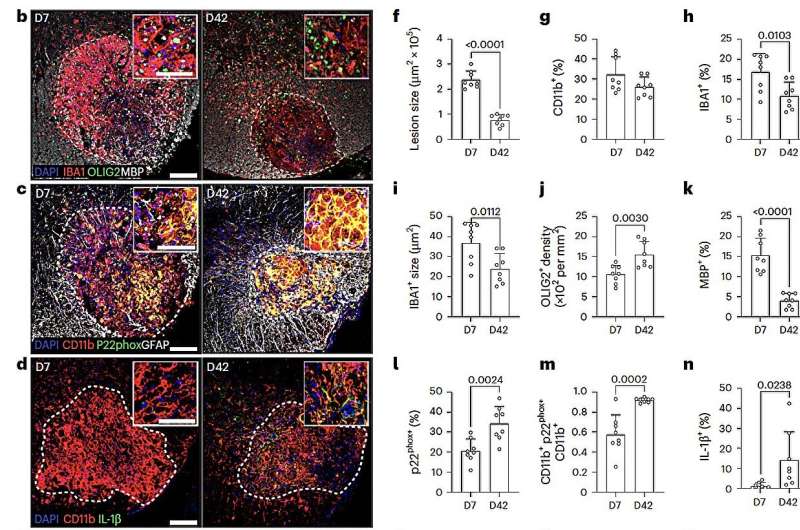
OxPC deposition induces chronic demyelination, neuroinflammation, endogenous lipid peroxidation and neurodegeneration in the CNS. Credit:Nature Neuroscience(2025). DOI: 10.1038/s41593-025-02113-y.
Multiple sclerosis (MS) is a disorder that prompts the body's immune system to attack myelin, the protective sheath covering nerve cells in the brain, optic nerve and spinal cord. This can in turn result in vision impairments, reduced mobility, numbness, loss of coordination and other symptoms.
Progressive MS or P-MS is a sub-type of MS in which symptoms start gradually and steadily worsen over time. While many studies have tried to better understand the neuro-biological processes underpinning this progressive damage to nerve cells and related symptoms, these processes have not yet been fully elucidated.
Researchers at University of Saskatchewan, University of Montreal, University of Calgary and other institutes carried out a study investigating the possible contribution of neuroinflammation and oxidative stress (i.e., an excess of reactive oxygen molecules that can damage cells) to P-MS.
Their paper,publishedinNature Neuroscience, offers new insight into how chemically altered molecules produced by oxidative stress, immune cells and inflammatory signals collectively drive the chronic neurodegeneration observed in patients diagnosed with the disorder.
"Oxidized phosphatidylcholines (OxPCs) are neurotoxic byproducts of oxidative stress elevated in the central nervous system (CNS) during progressive multiple sclerosis (P-MS)," Ruoqi Yu, Brian M. Lozinski and their colleagues write in their paper. "How OxPCs contribute to the pathophysiology of P-MS is unclear."
To explore the possible contribution of OxPCs to P-MS, the researchers first created a new mouse model of MS. Specifically, they injected these neurotoxic molecules into specific regions of the mice's brains, via a procedure known as stereotactic surgery.
"We show that stereotactic OxPC deposition in the CNS of mice induces a chronic compartmentalized lesion with pathological features similar to chronic active lesions found in P-MS," wrote the authors.
"Using this model, we found that although microglia protected the CNS from chronic neurodegeneration, they were also replaced bymonocyte-derived macrophagesin chronic OxPC lesions. Aging, a risk factor for P-MS, altered microglial composition and exacerbated neurodegeneration in chronic OxPC lesions."
Yu, Lozinski and their colleagues studied the brains of the mice after the introduction of OxPCs and found that they exhibited similar patterns to those observed in patients diagnosed with P-MS. They then tracked the behavior of different types of immune cells, while also comparing the brains of younger and older mice.
The findings they collected revealed that while microglia (i.e., the brain's resident immune cells) initially helped to protect nerve cells, they were gradually replaced by more damaging immune cells, known as blood-derived macrophages. These detrimental immune responses appeared to be more pronounced in older mice, leading to greater neurodegeneration.
As part of their study, the researchers also examined mice that lacked enzymes known to activate inflammatory signals (i.e.,Caspase-1and Caspase-4). Moreover, they tried to reduce inflammation in some mice by shutting down a key inflammatory pathway.
Notably, they found that both these conditions significantly reduced damage to nerve cells. These results confirm that oxidative stress and neuroinflammation are key drivers of chronic neurodegeneration in P-MS.
"Amelioration of disease pathology in Casp1/Casp4-deficient mice and by blockade of IL-1R1 indicate that IL-1β signaling contributes to chronic OxPC accumulation and neurodegeneration," writes Yu. Lozinski and their colleagues.
"These results highlight OxPCs and IL-1β as potential drivers of chronic neurodegeneration in MS and suggest that their neutralization could be effective for treating P-MS."
Other research teams could soon try to replicate the team's findings and shed further light on the contribution of OxPCs and IL-1β inflammatory signaling to P-MS.
Eventually, this recent study could contribute to the introduction of new treatment strategies that slow down progressive neurodegeneration by preventing oxidative damage or blocking inflammatory pathways.
© 2025 Science X Network
More information Ruoqi Yu et al, Oxidized phosphatidylcholines deposition drives chronic neurodegeneration in a mouse model of progressive multiple sclerosis via IL-1β signaling, Nature Neuroscience (2025). DOI: 10.1038/s41593-025-02113-y . Journal information: Nature Neuroscience









Post comments