




































bySanjukta Mondal, Medical Xpress

People who received c-hGH hormone treatment in childhood developed early-onset dementia, mainly with language problems. Credit: cottonbro studio: https://www.pexels.com/photo/an-elderly-man-opening-a-window-curtain-8860207/
Alzheimer's disease (AD) is a neurodegenerative disorder that takes away a person's memory, thinking skills, and eventually the ability to perform basic tasks. Arecent studyhas provided further evidence that the disease could be transmitted through rare childhood medical treatments that are no longer used today.
The researchers studied four men who, as children, had received cadaveric pituitary-derived human growth hormone (c-hGH), which is a growth hormone treatment derived from deceased donors.
After following the participants for years and observing their symptoms as they grew older, the team found that these men experienced early-onset dementia. Their symptoms started showing at a younger age—between 47 and 60—and one of the first signs of cognitive decline was language and speaking difficulties.
The findings are published inJAMA Neurology.
Risks of receiving cadaver-based treatments
Research shows that neurodegenerative diseases such as Alzheimer's, Parkinson's, and dementia are driven by the harmful buildup ofmisfolded amyloid-betaproteins that can self-propagate, along with insoluble tangles formed by the abnormal accumulation of hyperphosphorylated tau protein inside neurons.
Together, these toxic changes interfere with how brain cells communicate, create inflammation, and gradually kill neurons that, in turn, cause a decline in memory, thinking and sometimes even motor activities.
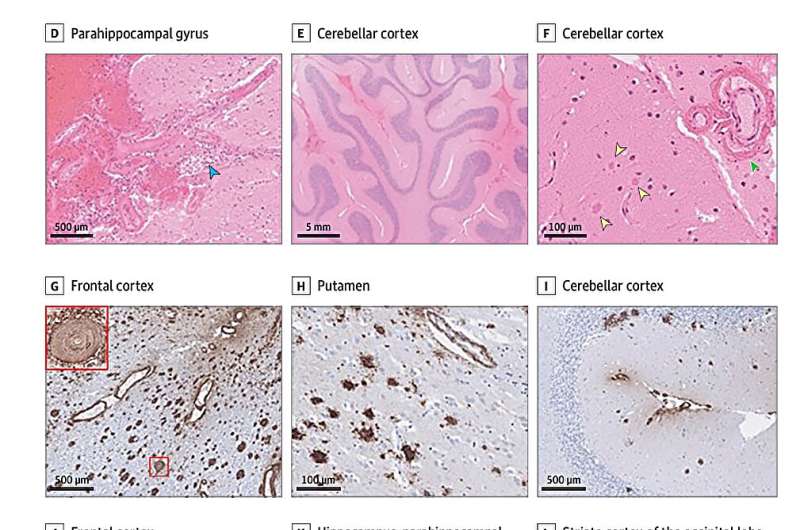
Imaging of postmortem findings. Credit:JAMA Neurology(2026). DOI: 10.1001/jamaneurol.2026.0437
In the 1960s and 80s, there was a trend of doctors giving children with growth issues c-hGH, a human growth hormone taken from the pituitary glands of people who had died. What the medical community was unaware of at that time were certain risks associated with hormones that were drawn from cadavers, such as possible transmission of the harmful protein folds from the donor to the receiver.
Some people who received these growth treatments as children developed a rare brain disease called Creutzfeldt-Jakob disease.
In more recent studies, researchers have found cases where patients developed a form of Alzheimer's disease after receiving these treatments, even though they did not have genetic risk factors.
Links between childhood treatments and brain decline
When researchers first identified iatrogenic Alzheimer's disease (iAD)—a form of Alzheimer's thought to result from medical transmission rather than aging or genetics—it was met with significant skepticism, with many questioning whether it truly fits the criteria of classic Alzheimer's disease.
Previous iAD studies reported limited tissue data, showing mild brain changes and amyloid-beta deposition, but lacked sufficient postmortem evidence and details on tau pathology.
In this study, the researchers examined iAD in four individuals—one postmortem case and three living participants—all of whom had receivedc-hGH treatmentsin childhood that were later found to be contaminated with amyloid-β seeds.
They maintained detailed records of each patient's medical history and current symptoms through routine clinical care, obtained brain MRI scans, and carried out genetic analyses to rule out the possibility of inheriting the disease. For the participant who died at age 57, the team performed a brain-restricted autopsy.
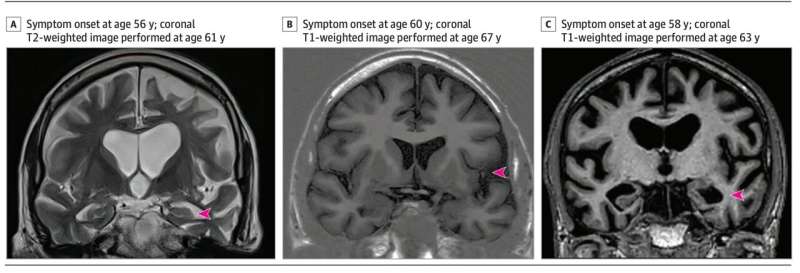
Magnetic resonance head imaging from three cadaveric pituitary–derived human growth hormone recipients with dementia syndromes characterized by early and prominent language involvement. Credit:JAMA Neurology(2026). DOI: 10.1001/jamaneurol.2026.0437
After examining a wide range of Alzheimer-related genes, the researchers confirmed that the patients did not carry any of those genetic risk factors. They, however, found that all four men who received c-hGH developed early-onset dementia, with predominantly language and speech difficulties.
The one postmortem autopsy case revealed signs of classic Alzheimer's disease with severe amyloid-β and tau deposition. The three remaining patients also had abnormal amyloid levels in their cerebrospinal fluid and their brain scans revealed significant shrinkage in the left areas of the brain, which are responsible for memory and language.
The researchers believe that studying this unique group offered a rare view into amyloid-β and tau transmission, accumulation and interaction over time.
These new insights can help health care professionals identify and manage symptoms in individuals exposed to cadaver-derived growth hormones, while also informing the development of more effective future treatments.
© 2026 Science X Network
Publication details Gargi Banerjee et al, High-Level Alzheimer Disease Neuropathological Change Following Iatrogenic Exposure, JAMA Neurology (2026). DOI: 10.1001/jamaneurol.2026.0437 Brian S. Appleby et al, Signal, Speculation, and Standards of Proof in Iatrogenic Alzheimer Disease, JAMA Neurology (2026). DOI: 10.1001/jamaneurol.2026.0421 Journal information: Archives of Neurology









Post comments