




































byQueen Mary, University of London
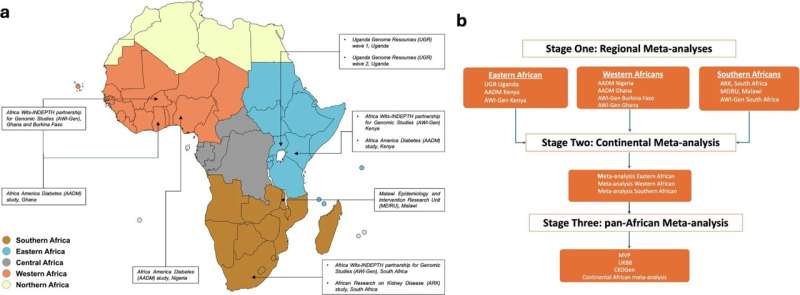
Data sources and overview of the study design and approach. Credit:Nature Communications(2026). DOI: 10.1038/s41467-026-69367-3
An international research collaboration led by Queen Mary University of London and University of the Witwatersrand (Wits) in South Africa has published the most comprehensive genomic investigation of kidney function ever conducted in African populations. The study sheds new light on the genetics of chronic kidney disease (CKD) across diverse African populations and will support future work aimed at improving prevention, diagnosis and treatment of kidney disease among these populations and worldwide.
Published inNature Communications, thestudyanalyzed genomic data from approximately 26,000 individuals across Eastern, Western, and South Africa, alongside 81,000 individuals of African ancestry in the diaspora. The research, conducted through the KidneyGenAfrica consortium, represents the largest genome-wide association study (GWAS) of kidney function in continental Africans to date, expanding previous regional sample sizes by eightfold.
Using a three-stage GWAS meta-analysis of estimated glomerular filtration rate (eGFR)—a key biomarker of kidney function—the team identified four genome-wide significant genetic loci in continental African populations, including two previously unreported variants. A broader pan-African analysis identified 19 significant loci, three of which are novel.
Burden of kidney disease in Africa
Chronic kidney disease affects an estimated 850 million people worldwide. The impact of the disease is felt most acutely in Africa, where rates of disability and death remain disproportionately high—a consequence of limited access to care forkidney failure, but also a deeper research gap.
Most genetic research into the condition to date has focused on European populations, leaving significant gaps in our understanding of the biological drivers of kidney disease risk in Africa. This study, which identified severalnew variantscommon in African populations but entirely absent in European and Asian populations, highlights the importance of conducting genomic research directly within African populations rather than extrapolating from studies conducted elsewhere.
Power of African-led collaborations
Professor Segun Fatumo, Professor and Chair of Genomic Diversity at Queen Mary's Precision Healthcare University Research Institute, said, "This study marks a major milestone for genomic research in Africa. By combining data from across Eastern, Western and Southern Africa, as well as the African diaspora, we have been able to uncover genetic insights that would have been impossible to detect otherwise.
"These findings show clearly that when African scientists and global partners work collaboratively, we can generate discoveries that not only deepen our understanding of kidney disease but also move us closer to equitable genomic medicine. KidneyGenAfrica demonstrates the power of partnerships to accelerate science that benefits communities in Africa and around the world."
Dr. June Fabian, nephrologist and co-lead of KidneyGenAfrica and Director of the Wits Donald Gordon Medical Research Institute at Wits University, explains, "Our study demonstrates the importance ofwidening diversityin genomic datasets. While historical datasets have been invaluable for genomic research, adding more data from the same populations is now yielding fewer new insights.
"Studying the rich genetic diversity found in African populations opens the door to discovering variants and biological pathways that may not be visible elsewhere, strengthening genomic science for everyone."
Insights for equitable genomic medicine
The study also examined polygenic scores (PGS), tools that combine many genetic variants to estimate disease risk. Scores derived fromgenetically similar populationsperformed significantly better than those based on larger but more genetically distant datasets. This finding highlights the importance of population matched reference data for developing equitable genomic medicine tools.
One of the study's most striking findings was in relation to the APOL1 gene. Variants in APOL1 are known to increase kidney disease risk threefold in African Americans and are strongly associated with progression to kidney failure. Surprisingly, the findings show that in continental Africa, these high-risk variants occur at lower frequencies and with reduced effects on kidney function when compared to the African American diaspora—suggesting that the genetic architecture of kidney disease may differ between African Americans and continental African populations.
Publication details Abram B. Kamiza et al, KidneyGenAfrica multi-cohort Genome-wide association study and polygenic prediction of kidney function in 110,000 Africans, Nature Communications (2026). DOI: 10.1038/s41467-026-69367-3 Journal information: Nature Communications











Post comments