




































byKing's College London
Credit: Pixabay/CC0 Public Domain
Project MinE, an international consortium co-founded by researchers at King's College London, has identified new genetic variants that play a role in the development of motor neuron disease (MND). These findings mean that a genetic component is identifiable for 1 in 4 people with MND, a sizable increase from previous estimates of 1 in 5.
The research, led by University of Utrecht andpublishedinNature Genetics, analyzed DNA from more than 18,000 people with MND, with 2,000 of the samples from the UK MND DNA Bank, a project led by King's College London, involving King's College Hospital NHS Foundation Trust.
Genetic variants can influence how clinicians manage MND, as some variants may influence prognosis.Newly identified mutationsmay also be inherited, making them relevant for family members. This discovery will therefore inform treatment plans, including family genetic testing, and may also contribute to the development of targeted treatments for patients in the long term.
MND is a condition in which the nerves controlling movement stop working. This causes progressively worsening paralysis and eventual death on average about two years after diagnosis. About 10% of people have a family history of the illness.
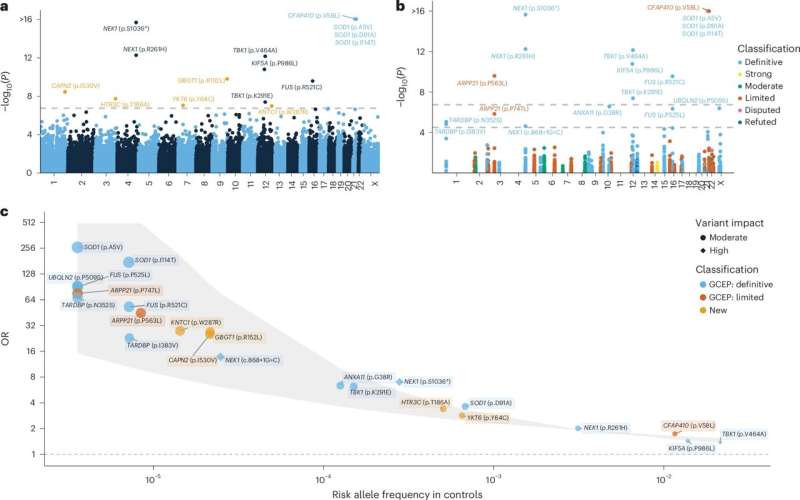
Rare single-variant analyses. Credit:Nature Genetics(2026). DOI: 10.1038/s41588-026-02535-9
The study established that 25% of people with the disease—regardless of whether the disease runs in the family—have a genetic change related to their MND. This contributes to a growing body of evidence that genes are key players in its development.
The unprecedented size of the data set allowed researchers to find previously unknown rare genetic mutations. Previous studies have focused either on genes inherited across a family or common genetic mutations in unrelated people. The large dataset used by the MinE project meant that researchers could identify rare mutations across the population.
All of these genetic variations represent new potential targets for treatments. For most people with MND, there is still no treatment available. In 2022, the drugTofersenmarked the first breakthrough in treating a genetic form of MND. This drug works for people with MND who have a variation of the SOD1 gene. In the U.K., this applies only to about 2% of patients. The new genes identified by this study offer new targets for future similar treatment approaches.
"This study appreciably increases our knowledge of what causes MND, showing that it has a significant genetic component in about a quarter of people with the disease, regardless of family history. That means everyone presenting with symptoms should be offered genetic testing, and this increased knowledge improves the chances of developing an effective treatment," said Ammar Al-Chalabi, Professor of Neurology and Complex Disease Genetics at King's College London, co-Director of the UK MND Research Institute and Theme Lead for MND at NIHR Maudsley BRC.
Publication details Paul J. Hop et al, Large-scale exome analyses reveal new rare variant contributions in amyotrophic lateral sclerosis, Nature Genetics (2026). DOI: 10.1038/s41588-026-02535-9 Journal information: Nature Genetics









Post comments