




































by Matthew Campbell,University of Hawaii at Manoa
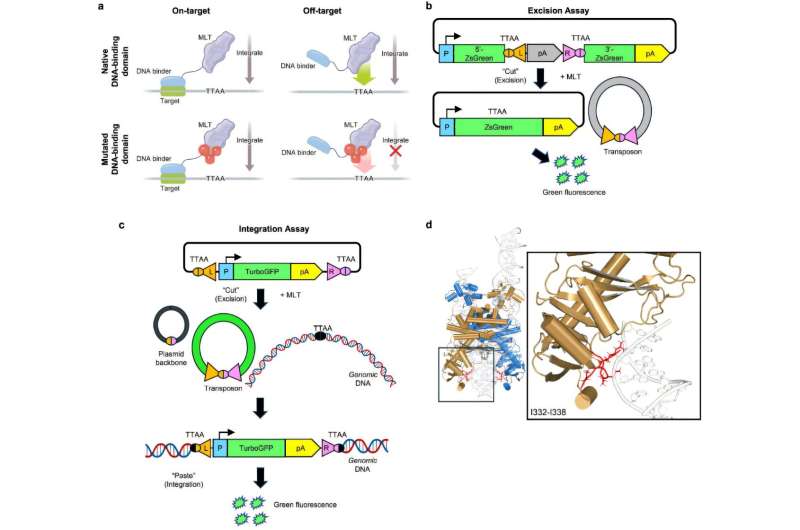
Identification of Exc+Int⁻ DNA-binding domain mutants to minimize off-target integration. Credit:Nucleic Acids Research(2025). DOI: 10.1093/nar/gkaf1316
JABSOM Cell and Molecular Biology researcher Dr. Jesse Owens has spent the better part of two decades chasing a vision that began with the revolutionary idea that DNA can move itself. Now, his team's latest breakthrough ispublishedinNucleic Acids Research. It marks a major step forward in gene therapy and could one day help correct life-threatening genetic disorders.
In the natural world, bits of genetic code known astransposons, sometimes called "selfish DNA," have the ability to pick themselves up and move around the genome. The phenomenon was first discovered in corn by Nobel Prize winner Barbara McClintock. Today, those same mobile bits of DNA are being repurposed in labs across the world as powerful tools for genetic medicine.
"What we've done in our lab," said Owens, "is take this natural jumping mechanism and use it to deliver healthy genes into the genome, essentially replacing a faulty one with a working copy."
Owens explains that the approach could one day be used to treat diseases likehemophilia, where a single defective gene prevents the body from making a vital blood-clotting protein. "By inserting a corrected version of that gene, the body could start producing the protein again and essentially cure the disease at its source," he said.
Early transposon systems were limited because they jumped randomly, landing unpredictably within the genome. Dr. Owens and his team wanted to change that. "The goal was to take control and guide where the transposon lands," he explained. "We're essentially steering a helicopter to a helipad, instead of letting it land anywhere it wants."
By engineering a way to target transposons precisely to "safe harbor" regions of DNA, areas open for gene expression but far from cancer-related genes, Owens' group achieved record-setting accuracy and efficiency.
In their latest work, the team reached an average of 1.2 successful insertions per cell, an extraordinary leap from results just several years ago that achieved less than 0.1% efficiency. "That means nearly every cell we worked with received the new gene," said Owens. "It's a huge jump, more than a thousandfold improvement."
Owens' team will continue developing the next generation oftransposon-based therapies. Their next target is to use this technology in CAR T-cell immunotherapy, which reprograms the immune system to hunt and destroy cancer cells.
"This research began here in Hawaiʻi, and it's now on the brink of something that could impact lives worldwide," Owens reflected. "It's exciting to see how far we've come and how much farther we can go."
More information James E Short et al, Gene-sized DNA insertion at genomic safe harbors in human cells using a site-directed transposase, Nucleic Acids Research (2025). DOI: 10.1093/nar/gkaf1316 Journal information: Nucleic Acids Research






Post comments