




































byUniversity of Queensland
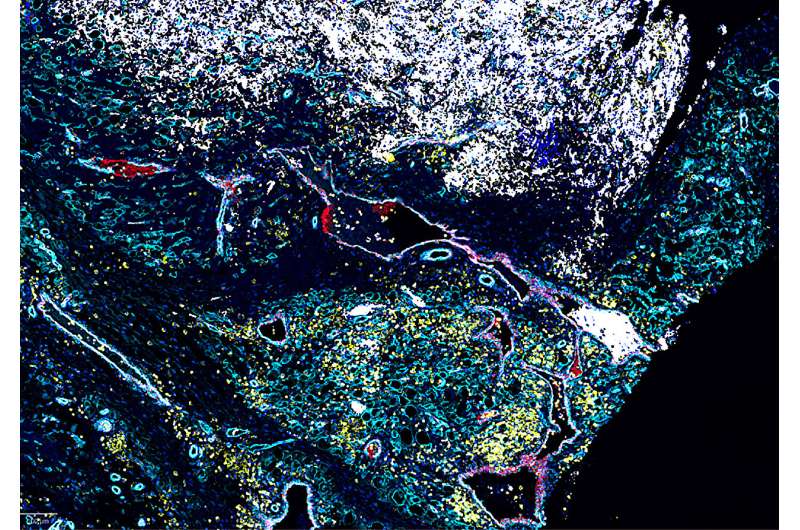
Neuroblastoma imaging showing cancer cells (white), immune cells (yellow) supportive tissue (blue) and blood vessels (red). Credit: University of Queensland
Researchers have created a detailed map of a deadly childhood cancer, showing it uses "shields" and "bodyguards" to protect itself, paving the way for new treatments. The team's paper, titled "Spatial multi-omics characterization of neuroblastoma reveals ferroptosis-associated metabolic features in high-risk tumors," appears inGenome Medicine.
The University of Queensland researchers used cutting-edge technology to map the biology of neuroblastoma—a cancer that typically develops in children under the age of 5—finding a hidden "shield" the tumors use as protection. Certain immune cells surrounding the tumor were also discovered to act as "bodyguards" for the cancer.
Associate Professor Fernando Guimaeres of UQ's Frazer Institute said his team used detailed spatial technology to map neuroblastoma tumor samples from 27 pediatric patients.
"Neuroblastoma is one of the most dangerous cancers in young children and represents about 10% of all pediatric cancer deaths," Dr. Guimaraes said. "Despite decades of intensive treatment, survival rates for the most aggressive cases remain stubbornly low. This research opens a new avenue for treatment by identifying a specific vulnerability in these tumors that could be targeted by drugs already in development."
Spatial mapping technology allowed researchers to create high-resolution 2D maps of tissue samples to see the precise location of cells and molecules.
Dr. Guimaraes explained that the technology allowed researchers to look at a tumor "like asatellite map" to see exactly which cancer and immune cells are present and where they sit in relation to each other.
"Before this technology, it was a bit like trying to understand a city just by reading a list of its residents; you'd have no idea who lives next to whom or which neighborhoods are dangerous," he said. "It's a relatively new technology, and our study is one of the first in the world to use it on this type of childhood cancer. We looked at which genes are switched on and which proteins are present, and exactly where in the tumor tissue these changes occur."
The research found that high-risk neuroblastoma tumors carry a hidden defense against a natural cancer-killing process calledferroptosis—caused by a build-up of toxic fats inside cancer cells—but a protein called GPX4 shielded the cancer cells from dying.
In the lab, switching off GPX4 killed neuroblastoma cells, identifying it as a promising drug target.
Study first author Dr. Cui Tu said there were alreadydrugs being testedfor adults that work by removing the "shield" the research team identified.
"Our findings suggest these drugs could be repurposed to treat children with high-risk neuroblastoma, potentially reaching clinical trials in coming years," she said."This is the kind of discovery that can move from the lab to a child's bedside relatively quickly because the drug pathway already exists."
Associate Professor Wayne Nicholls, UQ's Clinical Director of the Ian Frazer Centre for Children's Immunotherapy Research and Director of Oncology Services at Queensland Children's Hospital, said the research offered hope for new treatments.
"Neuroblastoma is one of the most heartbreaking cancers we see in children and for those with high-risk disease, outcomes remain devastating," he said. "This research uncovers a genuine vulnerability in the most aggressive tumors, one that could be targeted with new treatments. For our patients and their families, that is a real reason for hope."
Publication details Spatial multi-omics characterization of neuroblastoma reveals ferroptosis-associated metabolic features in high-risk tumors, Genome Medicine (2026). DOI: 10.1186/s13073-026-01622-0 Journal information: Genome Medicine







Post comments