




































byUniversity of Miami Leonard M. Miller School of Medicine
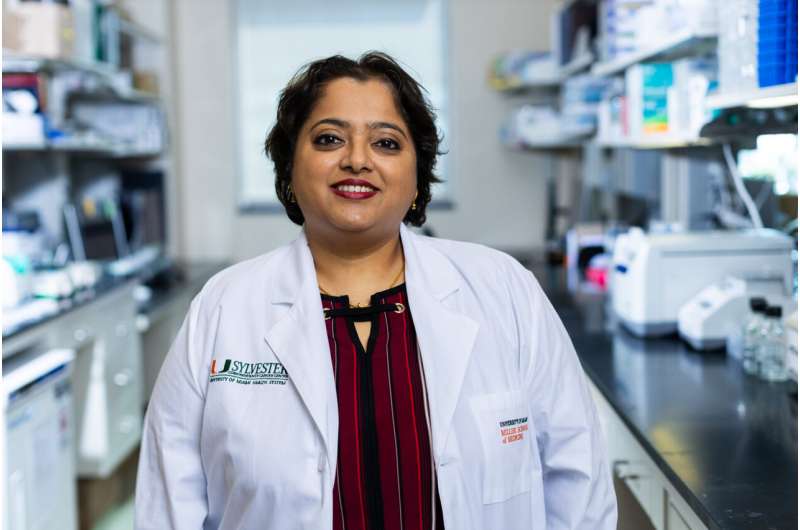
"This triple therapy approach could be a game-changer for patients whose (breast) cancers no longer respond to standard hormone treatments," said Rumela Chakrabarti, Ph.D., the study's senior author and co-director of Sylvester's Surgical Breast Cancer Research Group. "It's about hitting the cancer from multiple angles at once." Credit: Sylvester Comprehensive Cancer Center
In preclinical studies, researchers at Sylvester Comprehensive Cancer Center, part of the University of Miami Miller School of Medicine, have tested a new combination therapy for hormone-resistant, estrogen receptor-positive (ER+) breast cancer and were able to shrink tumors, reduce the number of cancer stem cells and reprogram the immune environment to be less supportive of cancer growth.
The findings were validated not only inpreclinical studiesbut also in patient-derived explants, and arepublishedinScience Translational Medicine.
Endocrine therapy has long been a cornerstone for treating estrogen receptor-positive (ER+)breast cancer, but a significant number of patients eventually develop resistance to drugs like tamoxifen and fulvestrant, leading to poorer outcomes and limitedtreatment options.
The new research sheds light on why this resistance occurs—and how it might be overcome by targeting the cellular "bodyguards" inbreast cancer cells.
To better understand the resistance mechanism, the research team focused on thetumor microenvironmentand created two ER+endocrine therapyresistant preclinical tumor models.
The tumor microenvironment can be thought of as the "neighborhood" surrounding a tumor, filled with various cells that can either help or hinder cancer growth.
Within this environment, tumor-associated macrophages (TAMs)—a type of immune cell—play a pivotal role, and the researchers found that a specific subtype of TAMs, marked by proteins called CD163 and PD-L1, are more abundant in patients whose tumors resist tamoxifen therapy. PD-L1 is a protein that helps cancer cells hide from theimmune system.
Drugs that block PD-L1, known as immune checkpoint inhibitors, have already revolutionized treatment for some cancers.
"These macrophages act like bodyguards for the cancer cells, helping them survive treatment," said Rumela Chakrabarti, Ph.D., the study's senior author and co-director of Sylvester's Surgical Breast Cancer Research Group.
"By understanding how they are brought to the tumor microenvironment and how they work, we can start to think about new ways to disrupt their support system."
The research team discovered that these PD-L1+ TAMs are recruited to the tumor by a signaling molecule called DLL1, produced by the cancer cells themselves. DLL1 acts like a beacon, drawing in macrophages through a pathway dependent on CCR3/CCL7.
Once in the tumor, these macrophages help maintaincancer stem cells—cells that can regenerate the tumor and are notoriously hard to kill with standard therapies. These immune suppressive macrophages also lead to exhaustion of the CD8-T cells, which kill the tumor cells.
In both preclinical studies and patient-derived tumor samples, higher levels of DLL1 and PD-L1+ TAMs were strongly linked to resistance against tamoxifen and fulvestrant, another common endocrine therapy. Notably, patients with a higher number of these cells in their tumors had worse survival rates.
To address this challenge, the team conducted preclinical studies to test a new combination therapy. By using antibodies that block DLL1 and PD-L1, alongside low-dose tamoxifen, they were able to shrink tumors, reduce the number of cancer stem cells, and reprogram the immune environment to be less supportive of cancer growth.
"This triple therapy approach could be a game-changer for patients whose cancers no longer respond to standard hormone treatments," said Chakrabarti, who is also an Associate Professor of surgery at the Miller School. "It's about hitting the cancer from multiple angles at once."
The researchers acknowledge that more work is needed before this approach can be translated into patient care by extended in vivo modeling and pilot clinical trials.
"Our models are robust, but human tumors are even more complex," Dr. Chakrabarti noted. "We're optimistic, but careful."
Understanding the interplay between cancer cells and their microenvironment is crucial for developing next-generation therapies. This research highlights the importance of looking beyond the tumor itself and considering the "ecosystem" that supports it. It's a reminder that cancer is not just a disease of rogue cells, but of complex cellular communities, said Chakrabarti.
"Every breakthrough brings us closer to a future where breast cancer is not just treatable, but truly manageable for every patient," she said. "We're committed to making that future a reality in the coming years."
More information: Shailesh Singh et al, DLL1-responsive PD-L1+ tumor-associated macrophages promote endocrine resistance in breast cancer, Science Translational Medicine (2025). DOI: 10.1126/scitranslmed.adr6207 . www.science.org/doi/10.1126/scitranslmed.adr6207 Journal information: Science Translational Medicine
Provided by University of Miami Leonard M. Miller School of Medicine








Post comments