




































byRutgers University

Credit: Pixabay/CC0 Public Domain
A study by Rutgers Cancer Institute researchers is the first to link ultra-processed foods to reduced survival in Black women with breast cancer.
The work ispublishedin the journaleClinicalMedicine.
Black patients with breast cancer who ate the most ultra-processed foods before diagnosis were 36–40% more likely to die from their cancers or other causes of death than those who ate the fewest ultra-processed foods.
"Black women have the highest mortality rate from breast cancer compared with other racial or ethnic groups in the U.S.," said Tengteng Wang, lead author of the study and a member of the Cancer Prevention and Control Program at Rutgers Cancer Institute, New Jersey's only NCI-designated Comprehensive Cancer Center, together with RWJBarnabas Health. "That's why we wanted to see what factors might contribute to these differences."
The researchers followed 1,733 Black women diagnosed with breast cancer in New Jersey between 2005 and 2019 in the Women's Circle of Health Follow-Up Study (WCHFS), which was led by Elisa Bandera, professor and chief of the Department of Medicine at Rutgers Robert Wood Johnson Medical School. During home interviews conducted about 10 months after diagnosis, participants completed detailed food questionnaires covering the year before their cancer was detected. Researchers then followed up with the women for a median of 9.3 years.
Women who ate the most ultra-processed food averaged more than eight servings per day. Those who ate the least averaged fewer than three servings daily. In addition to the 40% higher breast cancer mortality linked with the highest UPF intake, women in the top UPF consumption tier were 36% more likely to die of any cause than those in the lowest tier.
Ultra-processed foods are industrial formulations that typically contain additives, preservatives and ingredients not used in home cooking. The category includes most sodas, deli meats, sweets/desserts, salty snacks, pre-prepared fast foods/mixed dishes—basically everything in the center aisles of a supermarket—and it now accounts for roughly 40–60% of calories in the American diet.
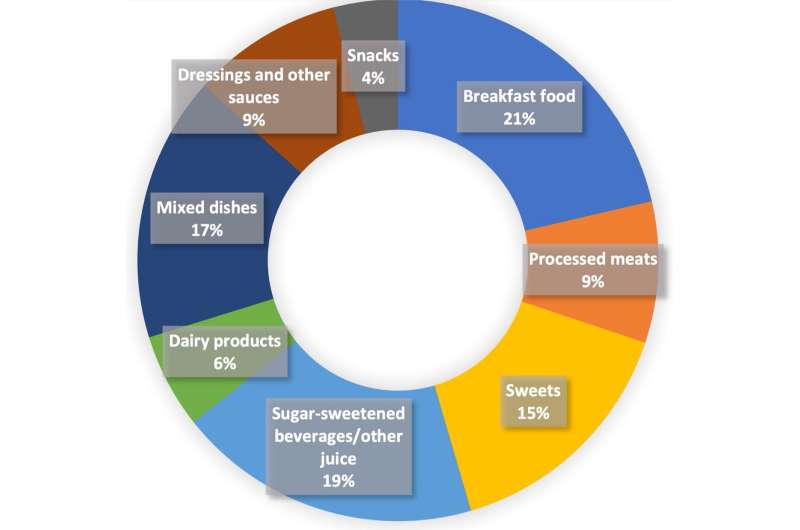
Credit:eClinicalMedicine(2026). DOI: 10.1016/j.eclinm.2025.103700
The findings echo the only other study to examine whether ultra-processed foods are associated with cancer death.Analysisof data from theUK Biobank, which tracks a predominantly white United Kingdom population, found a 22% increased risk of cancer-related death among cancer survivors who were high consumers of ultra-processed foods across all cancer types. The consistency suggests the potential underlying biological mechanism isn't race-specific.
"The average consumption is very similar to the U.K. population and also other U.S.-based studies like the Nurses' Health Study," said Wang, who is also an assistant professor at Rutgers Robert Wood Johnson Medical School. "I'd like to see more studies conducted among cancer survivors to confirm this, but the current evidence looks biologically reasonable now, particularly considering we have some ideas about the underlying biological mechanisms."
One link that connects them to cancer seems to be that they encourage people to overeat, which spurs weight gain and metabolic dysfunction. When Wang's team statistically adjusted for total calorie intake, the association between ultra-processed foods and mortality weakened considerably.
"The total energy intake may be one of the mechanisms, but it's not the only one because a positive association existed even after adjusting for caloric intake," Wang said.
Her team is conducting parallel analyses examining other potential pathways, including inflammation and insulin resistance. One forthcoming study will look atbreast cancer tissuestaken from the same women to see whether ultra-processed food consumption correlates with activation of the mammalian target of rapamycin signaling pathway, a cellular system involved in tumor growth. Another will examine blood-basedinflammation markerssuch as C-reactive protein and interleukin-6.
In the recently published study, when Wang's team examined whether particular foods were more associated with cancer deaths than others, processed meats emerged as the leading culprit. That finding aligns with previous research linking processed meat to cancer risk and poorer prognosis.
"Maybe it's too complicated for breast cancer patients to think about how to reduce consumption of ultra-processed foods in general," Wang said. "But we find processed meat is the top worst contributor among all UPF subgroups. So maybe a more detailed takeaway is to avoid this one thing."
The findings arrive as ultra-processed foods face mounting scrutiny from public health researchers. A major umbrella reviewpublishedlast year inThe BMJfound consistent associations between high ultra-processed food consumption and dozens ofadverse health outcomes, including heart disease, diabetes, depression and premature death.
Wang's research adds breast cancer survivorship to that list, and for anyone navigating life after a cancer diagnosis, points toward a modifiable risk factor. The study examined an understudied population, but researchers suspect the findings apply broadly.
"If you can't do everything," Wang said, "at least limit consumption of processed meat."
"Going back to cooking traditional meals can potentially save money and is generally better for your health," said Bandera, who is also co-leader of the Cancer Prevention and Control Research Program at Rutgers Cancer Institute.
More information Tengteng Wang et al, Ultra-processed foods consumption and subsequent mortality in a cohort of Black breast cancer survivors, eClinicalMedicine (2026). DOI: 10.1016/j.eclinm.2025.103700 . www.sciencedirect.com/science/ … ii/S2589537025006340 Journal information: British Medical Journal (BMJ) , EClinicalMedicine
Provided by Rutgers University










Post comments