




































byUniversity of Trento
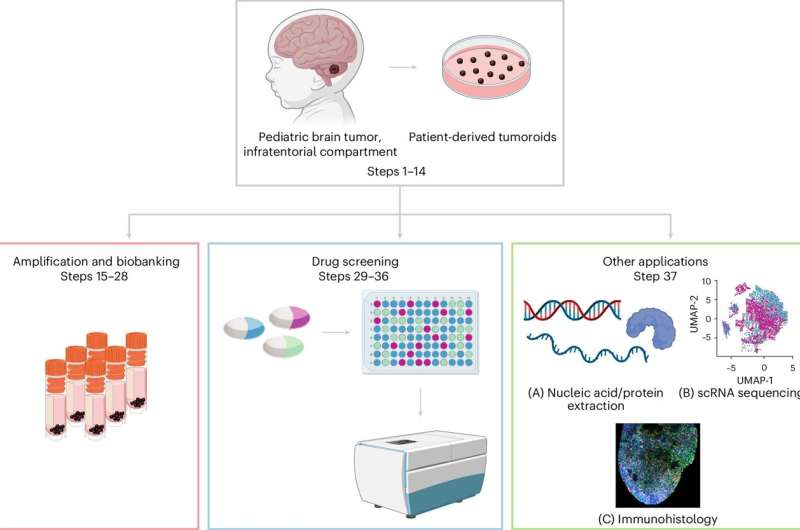
A summary of pPDT and pPDXT generation, amplification and biobanking and their use in drug screening and other applications. Credit:Nature Protocols(2026). DOI: 10.1038/s41596-026-01347-9
Biopsy-derived organoids, accurate models of disease, are used to search for new drugs. Now, results obtained by a study led by the University of Trento in collaboration with Bambino Gesù Children's Hospital in Rome may pave a path to an organoid that could be used to study two common, aggressive childhood brain cancers. The model organ for this research project is the best pediatric brain tumor model developed so far and can be used to test new drugs. The results of the project arepublishedin theNature Protocols.
In recent years,cancer researchhas switched from the study of two-dimensional assays (cultures on plastic) to organoids, more complex systems that make it possible to work in a three-dimensional environment and that allow for a more realistic observation of the disease. The model now makes it possible to make a qualitative leap in pharmacological screening.
"It is like studying what happens in vivo in a tumor avatar, with the advantage that you can verify the effectiveness of therapies without having to test them directly on sick children," explains Luca Tiberi, professor of the Department of Cellular, Computational and Integrative Biology of the University of Trento and project coordinator. The result is expected to have a positive impact on the international scientific and clinical community because it opens up unexplored possibilities.
Patient-derived organoids(PDOs) for cancer research, also called tumoroids, are generated from biopsies and can be used as models to understand the different responses to drugs. The 3D model accurately reproduces the human environment and represents a predictive tool for oncological pharmacological research because it maintains the molecular characteristics of the original tumor to be studied.
The research coordinated by Tiberi focuses on ependymoma and medulloblastoma, which are among the most common and aggressive malignant pediatric brain tumors.
"Biopsy-derived tumoroids preserve the phenotypic and structural complexity of the disease that is lost in 2D cultures and at the same time maintain a better cellular heterogeneity, which is lost in organoids derived from induced pluripotent stem cells to create disease models," explains Tiberi. "The organoids maintain the complexity of the tumor and therefore, we can test different therapies for a broader pharmacological screening. The bulk of the work is done here at the Cibio Department by a close-knit group of young Ph.D. students who give their dedication and time to advance research."
The contribution of the Bambino Gesù Children's Hospital, where young patients receive ongoing care, was fundamental. The hospital provided the biological samples and has also participated in the characterization of the organoids.
"These models provide a deeper understanding of the disease and allow for ever more precise study of treatment responses," explains Doctor Evelina Miele from the Oncohematology, Hematopoietic Transplant, Cell Therapies, and Trials Unit at Bambino Gesù.
"This protocol provides arobust and scalable platformfor the in-vitro modeling of pediatric brain tumors and will expand the adoption of patient-derived tumor systems for preclinical pharmacological studies and screening in pediatric neuro-oncology research," Tiberi says.
Meanwhile, research also continues to find suitable models to test new drugs for other less aggressive types of pediatric brain tumors, such as low-grade pediatric glioma.
Publication details Chiara Lago et al, Patient-derived ependymoma and medulloblastoma tumoroids: generation, biobanking and drug screening, Nature Protocols (2026). DOI: 10.1038/s41596-026-01347-9 Journal information: Nature Protocols







Post comments