




































byKing's College London
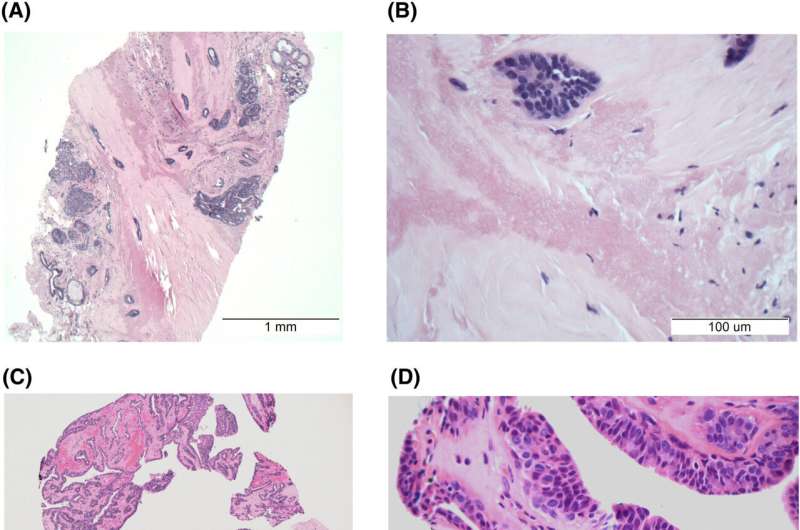
Histology of, and age at diagnosis for, RS/CSL and papillary lesions without atypia. Credit:Histopathology(2025). DOI: 10.1111/his.70017
Researchers at King's have found that certain breast lesions identified during routine screening may not always require removal. The findings could help reduce unnecessary procedures while maintaining high standards of patient safety.
The study,published inHistopathology, examined outcomes for women diagnosed with two types of non-cancerous breast tissue changes: radial scars/complex sclerosing lesions (RS/CSL) and papillary lesions when these did not show atypia, meaningabnormal changesincell size, shape, or organization that can indicate a higher future cancer risk.
Currently, many women with these findings undergo vacuum-assisted excision (VAE), a minimally invasive procedure used to remove additional tissue for testing. However, the research suggests that some patients may not need this procedure and could instead be safely monitored with mammographic surveillance.
Between 2017 and 2023, researchers from King's reviewed cases at the King's College Hospital Breast Screening Unit. They found that only 1% of women with RS/CSL and 4% of women with papillary lesions were later found to have cancer at the biopsy site. These results indicate that, for RS/CSL in particular, the likelihood of malignancy is low, suggesting that some patients could be managed through ongoing imaging rather than excision.
"We are among the first in the UK to add to the growing body of evidence that suggests that women who have RS/CSL without atypia could avoid excision. Rather, the data suggests that we could observe these lesions. This lessinvasive approachcould improve how we care for a subset of patients in the Southeast going forward," says Dr. Kalnisha Naidoo, Adjunct Senior Lecturer in Translational Pathology and senior author.
Dr. Naidoo continued, "On the other hand, our study highlights that more work is needed in understanding papillary lesions, which appear to carry a higher risk of malignancy even in the absence of atypia. This is something we aim to follow up on in our service over the next few years."
While the findings highlight the potential to reduce overtreatment and improve patient experience, the authors emphasize the importance of consistent national reporting of these types of lesions. Variation in how atypia is recorded within the NHS Breast Screening Programme currently makes it difficult to compare data between centers and to develop standardized national guidelines.
"We hope our findings will help reduce unnecessary excisions for patients with RS/CSL and encourage other centers to evaluate their outcomes for papillarylesionswithout atypia, with the aim of developing evidence-based standardized national guidelines," says Dr. Amy Llewellyn, Histopathology Registrar and Ph.D. student.
More information: Amy Llewellyn et al, To VAE or not to VAE: outcomes of radial scars/complex sclerosing lesions and papillary lesions without atypia in the King's College Hospital breast service (2017–2023), Histopathology (2025). DOI: 10.1111/his.70017
Provided by King's College London









Post comments