




































byUniversity of Rhode Island
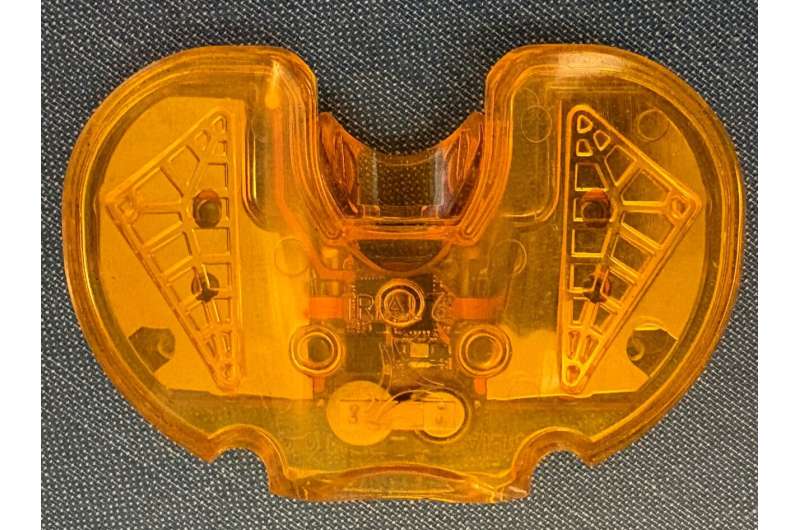
Verasense is a wireless, single-use sensor that measures real-time load, balance, and surgical alignment of the knee during total knee replacement, providing surgeons with data to optimize implant positioning and soft tissue balance. Chapman worked on the device as a Ph.D. student at Dartmouth College and completed it at URI. Credit: URI
Joint replacement surgery has advanced dramatically thanks to new materials, techniques, and technology. Procedures are safer, less invasive, and require less recovery time. There have also been great advancements in technology used to remotely monitor how patients recover from joint replacement surgery, also known as arthroplasty. However, these technologies have not yet been widely implemented.
At the University of Rhode Island, Ryan Chapman, assistant professor of kinesiology in the College of Health Sciences, is developing orthopedic technologies to improvepatient outcomes. Chapman and colleague Professor Janie Astephen Wilson of Dalhousie University in Halifax, Canada examined the state of technology used for remote patientmonitoringfollowing joint replacement.
Their peer-reviewed article is published in theJournal of Orthopaedic Research.
Sensors can now be embedded in implants during knee replacement surgery and can be used for gait and load sensing, activity monitoring, and implant micromotion detection. Chapman and his collaborators developed a device for implants which uses agyroscope-based systemto measure the alignment of the tibia coronal plane in knee replacements.
Emerging technologies for post-surgery monitoring includemobile applications,wearable sensorsfor mobility and temperature sensing, smart textiles, and sensor-enabled smart homes.
"Together, these technologies hold promise for more personalized, cost-effective strategies for comprehensive and patient-centered assessments that can inform tailored rehabilitation approaches, allow for near real-time assessment of patient outcomes, improve function, and promote earlier mobilization," wrote Chapman and Astephen.
Chapman has established himself as a leading expert in the development of wearable motion sensors for monitoring patient recovery after joint replacements, earning patents for his novel technology and publishing several articles on the use of these technologies in monitoring recovery after knee, hip, and shoulder replacements.
Chapman presented his lab's advancements in wearable motion sensing in joint replacement at the International Society for Technology in Arthroplasty annual meeting in September in Rome, Italy.
According to Chapman, there are several reasons why the field of orthopedics has been slow to adopt e-health technologies for remote patient monitoring compared to other medical fields.
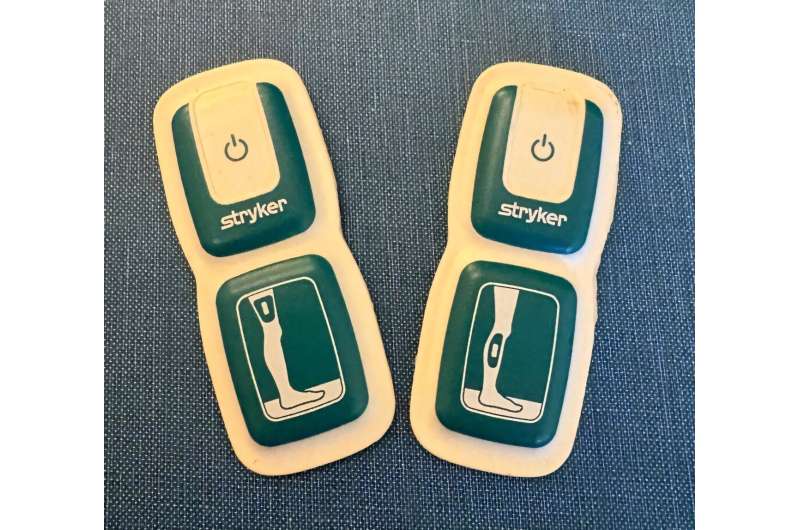
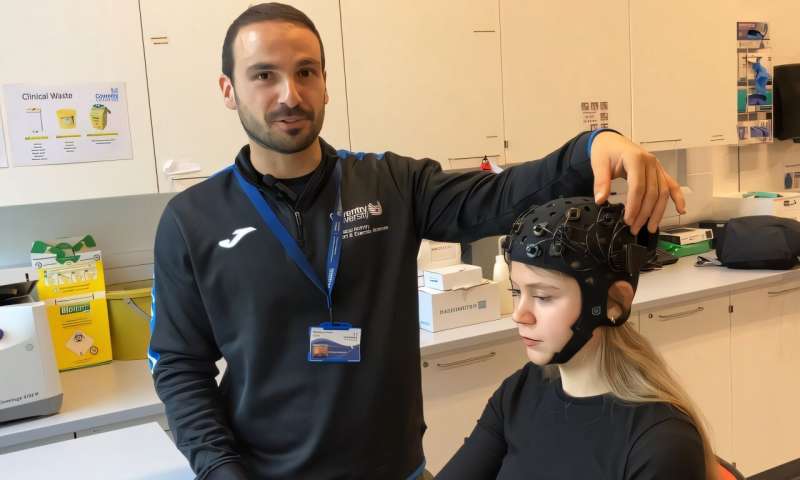
Motionsense is a wearable sensor platform that continuously tracks patient movement and activity after orthopedic procedures, providing real-world data on recovery and function. MotionSense was created at URI and co-developed by Stryker, a medical technology company. Credit: University of Rhode Island
"The plastic used in joint replacements used to break down rapidly inside the patient," said Chapman.
"Until that problem was solved, it didn't make sense to spend lots of time, money, and energy on remotely monitoring patients. Moreover, when joint replacements failed, it was often multivariable. Developing a technology to remotely monitor a variety of variables was challenging."
Now that joint replacements last longer and patients can resume anactive lifestylesooner, people are opting to have procedures at an earlier age and are starting to embrace technology used for post-surgery remote monitoring.
"The average age of individuals receiving joint replacements is 65 to 75," said Chapman.
"This demographic was historically significantly less interested in using technology to track their progress after a surgery. Now, that age range is starting to come down and individuals receiving joint replacements are far more technologically literate and accepting. As a result, we are beginning to see increased use of these remote monitoring technologies."
Despite advances in technology, Chapman and Astephen make the case that before remote arthroplasty monitoring technologies can be widely accessible and commonly used, several barriers need to be addressed.
Inconsistent protocols, the need for clinical validation, reliance on patient compliance with sensor use,privacy concerns, cost challenges, and limited long-term data are some of the issues that require further research and viable solutions.
"Each of those problems require subtly different, but also interrelated solutions," said Chapman.
"For example, sensor compliance means we need patients to follow protocols to use the technology appropriately. This may require incentivization, which could vary from one person to another. One patient might have internal motivation, a second may be driven by what their doctor says, and a third may be driven by playing a rehabilitation game."
Getting patients to embrace the technology often comes down to its functionality and design, which presents other challenges.
"Design choices for the sensors could change the cost, how we deploy it clinically, and if insurers are willing to pay for the technology," said Chapman.
"Cost and reimbursement challenges are highly dependent on the companies, insurers, and the government. Perhaps more important is the value of the technology in improving patient outcomes. If patients show significant improvement for equal or lower cost, the likelihood of adoption will increase."
Depending on the technology selected, costs can range from hundreds of dollars for a disposable wearable sensor up to tens of thousands of dollars for home-integrated sensing systems, making many of these technologies cost-prohibitive in the absence of insurance or other reimbursement strategies.
Chapman hopes his research team's efforts to develop these remote monitoring technologies will continue driving health care value by improving patient outcomes and improve access to high-quality health care around the world.
More information: Janie L. Astephen Wilson et al, Reimagining Outcomes: A Perspective Review of Advances in Remote Monitoring Technologies in Post‐Arthroplasty Patient Care, Journal of Orthopaedic Research (2025). DOI: 10.1002/jor.70064
Provided by University of Rhode Island







Post comments