




































byUniversity of Rochester Medical Center
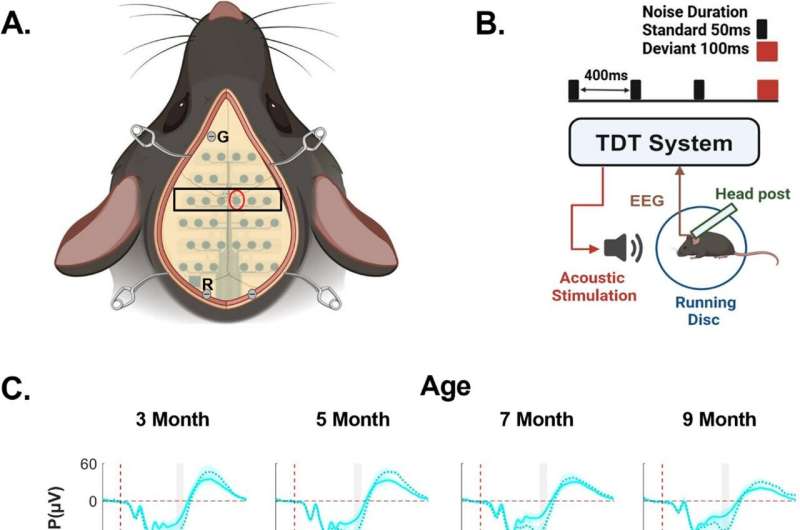
WT mice of both sexes showed robust auditory duration MMN responses. Credit:Journal of Neurodevelopmental Disorders(2025). DOI: 10.1186/s11689-025-09652-2
Batten disease is a rare inherited condition that affects brain development and function. CLN3 disease is the most common type of this disease. The symptoms are life-changing. They usually begin between the ages of four and seven. Children will experience vision loss, problems with cognition, movement, seizures, and difficulties with speech.
The symptoms make it a difficult disease to study, and how the disease progresses inmalesversus females is not well understood; however, it is common forfemale patientswith CLN3 to experience a later onset of symptoms compared to males and have a more rapid disease progression.
Researchers from the Del Monte Institute for Neuroscience at the University of Rochester have found that male and female brains show different responses as the disease progresses and have found a model of the disease that could transform future treatments, as explained in a paper published today in theJournal of Neurodevelopmental Disorders.
"Because vision and cognition decline early, it is hard for scientists to track how the disease progresses and develop reliable treatments using standard tests," said Yanya Ding, Ph.D., an alumna of the Neuroscience Graduate program in the Wang Lab and first author of the study. "Being able to successfully track brain functions in mice gives us a model that could transform how we study possible treatments and therapeutics for this devastating disease."
Using a noninvasive measure of brainelectrical activityknown as electroencephalography or EEG, and an audio test, researchers were able to detect how the brain responds to sound pattern changes in male and female mouse models of CLN3. They surprisingly discovered that male mice showed early auditory problems that improved with age, while female mice had persistent difficulties, evidence that both age and sex play important roles in the progression of Batten disease.
Previous researchled by the co-senior author of this study, John Foxe, Ph.D., principal investigator of the Fredrick J. and Marion A. Schindler Cognitive Neurophysiology Lab at the University of Rochester, identified the easy-to-measure brain process or biomarker in human CLN3 patients that was used in this mouse study.
"These findings highlight the importance of trackingbrain functionover time and support the use of this EEG-based method as a valuable tool for monitoring disease progression and testing new treatments," said Kuan Hong Wang, Ph.D., professor of Neuroscience and co-senior author of the new study.
"By showing how Batten disease progresses differently in males and females, this research could help guide more personalized therapies and improve the timing of interventions for better outcomes."
The University is a designated Intellectual and Developmental Research Center (IDDRC), and its current principal project is aimed at neuromarker discovery in Batten disease. Several potential gene therapies for Batten disease are currently in advanced stages of development, and with a translational mouse model of the disease, the effectiveness of these experimental treatments can be tested and understood in new ways.
Other authors include Jingyu Feng, a co-first author, Viollandi Prifti, Grace Rico, Alexander Solorzano, Hayley Chang, and Edward Freedman, Ph.D., of the University of Rochester Medical Center.
More information: Yanya Ding et al, Sex-specific and age-related progression of auditory neurophysiological deficits in the Cln3 mouse model of Batten disease, Journal of Neurodevelopmental Disorders (2025). DOI: 10.1186/s11689-025-09652-2
Provided by University of Rochester Medical Center










Post comments