




































byCity University of Hong Kong
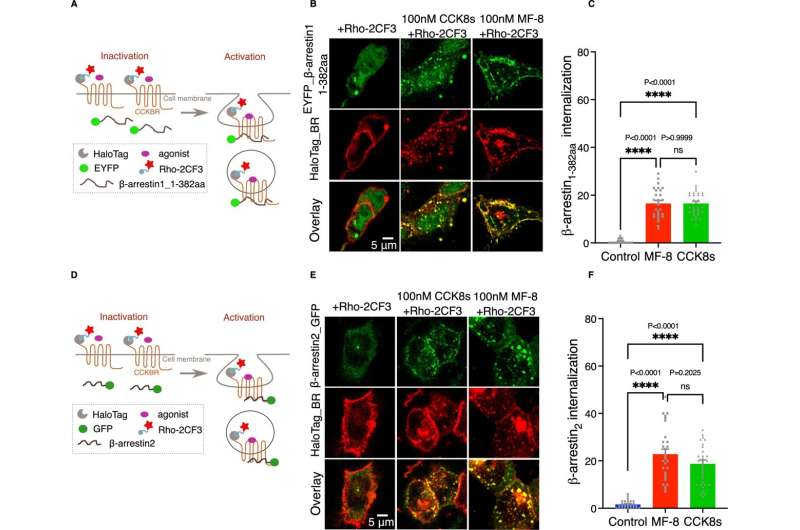
MF-8 is able to induce CCKBR internalization at a low concentration. Credit:Nature Communications(2025). DOI: 10.1038/s41467-025-65962-y
Scientists at City University of Hong Kong (CityUHK) have made progress in recent months with the discovery of a novel compound, named MF-8. The compound and its associated pharmaceuticals demonstrate significant potential to provide safer, more effective treatments for psychiatric and neurological disorders, such as memory impairment, depression and anxiety, while effectively mitigating the side effects associated with existing medications.
How MF-8 changes brain signaling
Led by Professor He Jufang, Head of the Department of Neuroscience (NS) and Wong Chun Hong Chair Professor in Translational Neuroscience, the research team developed MF-8, a novel cholecystokinin B-type receptor (CCKBR) agonist that exhibits high β-arrestin bias and potency.
CCKBRs are widely distributed throughout the brain and play a crucial role in regulating memory, emotion and anxiety. While it is known that CCKBRs enhance memory through long-term potentiation (LTP), the precise cellular signaling pathways involved have remained unclear. Furthermore, existing drugs lack precise pathway selectivity, making it difficult to distinguish therapeutic effects from side effects.
The newly discovered MF-8 may alter this landscape. The compound exhibits unique pathway selectivity, activating β-arrestin while effectively inhibiting the formation of associative fear memories. This could lead to new treatment options for related neurological disorders.
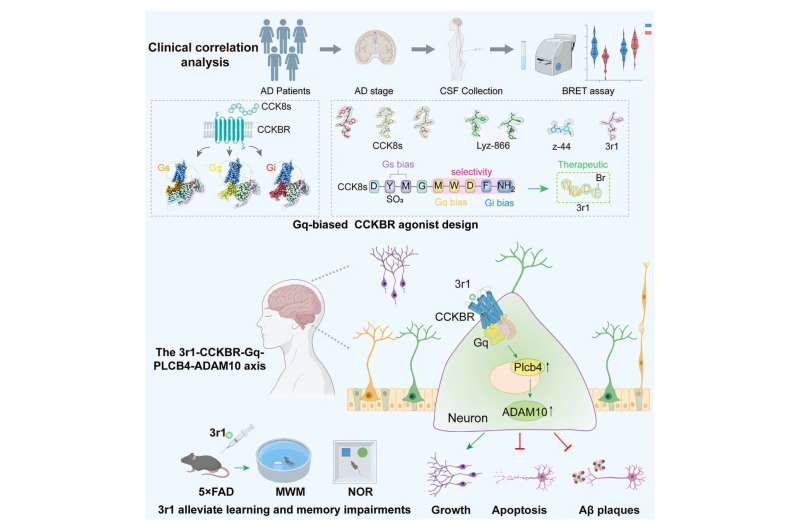
Credit:Cell(2026). DOI: 10.1016/j.cell.2025.10.034
To comprehensively verify MF-8's selectivity and functionality, the research team employed a multi-faceted validation approach, incorporating diverse cellular and animal experiments alongside molecular modeling. Throughmolecular dockingand mutation studies, they identified critical molecular sites required for MF-8 to induce β-arrestin bias, establishing a foundation for future drug design.
The findings werepublishedinNature Communicationsin a paper titled "Discovery of aβ-arrestin-biased CCKBR agonistthat blocks CCKBR-dependent long-term potentiation."
Professor He was the corresponding author of the paper. Members of the CityUHK research team included co-first authors Dr. Shi Heng, a postdoctoral fellow, and research assistant Dr. Zhang Mengfan, both from the NS.
Professor He remarked, "This research represents a significant milestone in neuroscience, providing crucial tools for fundamental neuroscience research and opening new avenues for developing treatments for fear-related disorders, anxiety conditions and neurodegenerative diseases."
Linking biased signaling to Alzheimer's
In addition, Professor He's team, in collaboration with Professor Jinpeng Sun from Peking University/Shandong University as a co-corresponding author, published aresearch papertitled "Elucidating pathway-selective biased CCKBR agonism for Alzheimer's disease treatment" inCell. The study found that CCKBR-Gs and -Gq signaling, but not CCKBR-Gi signaling, are beneficial for Alzheimer's disease treatment. This research provides new directions for targeting the downstream Gs and Gq signaling pathways of CCKBR in the treatment of Alzheimer's disease.
The team is optimistic that a deeper understanding of synaptic plasticity and memory formation mechanisms will lead to major breakthroughs in brain health in the future. Additionally, this research on bias agonists could inspire the development of more targeted drugs for membrane protein receptors, transforming the landscape of pharmaceutical research with significant benefits for society.
Publication details Heng Shi et al, Discovery of a β-arrestin-biased CCKBR agonist that blocks CCKBR-dependent long-term potentiation, Nature Communications (2025). DOI: 10.1038/s41467-025-65962-y Jia-Le Wang et al, Elucidating pathway-selective biased CCKBR agonism for Alzheimer's disease treatment, Cell (2026). DOI: 10.1016/j.cell.2025.10.034 Journal information: Cell , Nature Communications







Post comments