




































byJohns Hopkins University
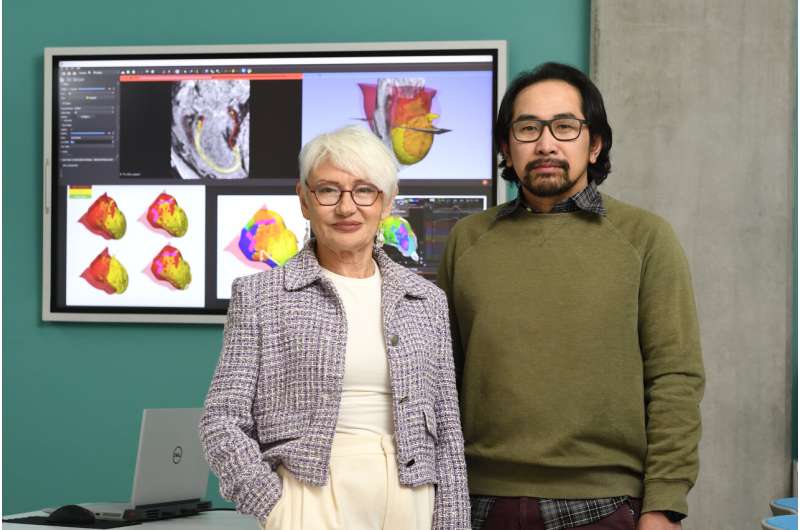
Senior author Natalia Trayanova and co-first author Adityo Prakosa. Digital twins of hearts are seen behind the researchers. Credit: Will Kirk/Johns Hopkins University.
Working with "digital twins" of patients' hearts, doctors have improved cardiac ablation outcomes for patients with life-threatening arrhythmias. In the first clinical trials for cardiac digital twins technology, researchers at Johns Hopkins University created digital replicas of patients' hearts, then tested procedures on those twins before performing them on the real thing. Working with digital twins resulted in faster and significantly more accurate procedures that reduced recurrences of arrhythmias for patients, compared to traditional methods.
"For patients, digital twins can be life-changing and life-saving," said first author Jonathan Chrispin, a cardiologist who specializes in treating arrhythmias. "We show we can make their procedures safer, shorter and more effective by targeting only the critical portions of the heart."
Medical digital twinsare computer models of organs that mimic an organ's behavior and have predictive capabilities. The cardiac models were developed at Johns Hopkins.
The digital twin can help doctors diagnose and treat issues as well as predict a patient's chances for complications based on their genetics and heart structure. The study,publishedin theNew England Journal of Medicine,demonstrated the approach's safety, feasibility, and promising outcomes.
Each of the 10 participants in theTWIN-VT trialhad experienced heart attacks and suffered from ventricular tachycardia, abnormal heart beats that can be life-threatening. The arrhythmias are typically treated with a procedure called ablation, which destroys tissue that sparks arrhythmias, but it can be hard for doctors to pinpoint the right spot or spots to ablate. The procedures are also very long with low success rates. Arrhythmias often return after ablation and it might have to be repeated several times before it works, which further scars and damages the heart.
For each participant in the trial, the team created apersonalized digital twinof their heart, based on 3D imaging from a clinical contrast-enhanced MRI. Through the digital twins, the team studied how each heart processed electricity and then predicted which area or areas was provoking the arrhythmias, the optimal way to treat each patient, and whether the arrhythmia would return after ablation.
"In the patient's digital twin, we can try different scenarios for treatment before we treat the actual patient and provide the treating physician with the best, most optimal scenario, minimizing damage to the heart, and increasing the potential for a successful treatment," said senior author Natalia Trayanova, the Murray B. Sacks professor of Biomedical Engineering, whose team developed the digital twin technology used in this clinical trial.
"The digital twin allows us to address all potential sources of arrhythmias that may not be seen by clinical interrogation. We exhaust all possibilities."
These digital-twin predicted targets were then imported into a system that navigates the ablation catheter in the procedure room. Chrispin and his team executed the streamlined ablation guided by the predictions of the patient's digital twin.
After the ablations, doctors couldn't stimulate arrhythmias in any of the subjects, indicating that the procedure was a success. Two patients experienced a brief episode while they were healing. More than a year later, all 10 were arrhythmia-free. The long-term success rate with traditional ablation treatment is just 60%. Here it was 100%.
In addition, eight patients were entirely off anti-arrhythmia medication and the remaining two had reduced their doses.
"We show the technology isn't merely feasible, it has excellent outcomes," Trayanova said. "This demonstrates a crowning achievement in this technology that allows us to go further toward a larger clinical trial."
The team expects to further test cardiac digital twins in a bigger trial. They are also working to make thetechnology accessibleon a desktop, which would provide information to doctors in minutes. They also plan to expand the technology to work with other cardiac diseases.
Publication details Digital Twin–Guided Ablation for Ventricular Tachycardia, New England Journal of Medicine (2026). DOI: 10.1056/NEJMc2517822 Journal information: New England Journal of Medicine






Post comments