




































by Jackie Maupin,Indiana University
Credit: Pixabay/CC0 Public Domain
Indiana University School of Medicine researchers are taking a closer look at how young patients respond to biologic treatments for asthma. By analyzing clinical parameters and identifying which children are still likely to have severe asthma attacks despite the use of specialized asthma medications, the team hopes to help health care providers intervene sooner and tailor treatment to each child's needs.
According to the Centers for Disease Control and Prevention, 4.6 million children younger than 18 have asthma in the United States, making it one of the most common childhood chronic diseases. Asthma affects the lungs and can cause wheezing, coughing and shortness of breath. With proper monitoring and treatment, symptoms can be controlled, but ineffective management can lead to severe flare-ups and dangerous asthma attacks.
Doctors often prescribe specialized medications that target certain pathways in the immune system to help patients with severe asthma. However, thesebiologic therapiesare not always as effective as expected. In a study recentlypublishedinPediatric Allergy and Immunology, IU scientists analyzed data from 122 children with moderate to severe asthma who were treated with a biologic prescribed by pediatric pulmonologists and allergists at Indiana University Health to understand why reactions to biologics varied.
"Our results demonstrate that, beyond a patient meeting existing guidelines for biologic treatment, routinely collected clinical parameters can help identify patients at an increased risk of severe asthma attacks," said Arthur Owora, Ph.D., MPH, associate professor of pediatrics at the IU School of Medicine, research scientist at Regenstrief Institute and first author of the study.
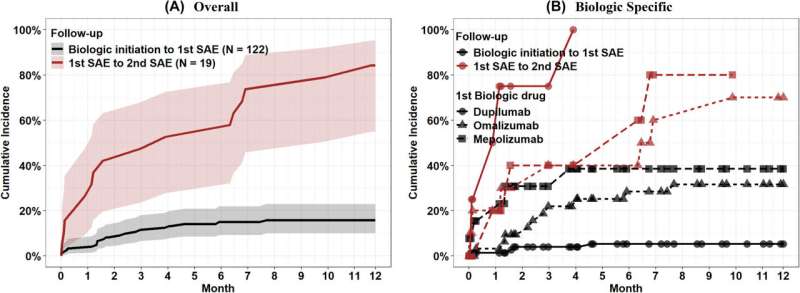
Cumulative Incidence and Recurrence of SAEs 12-months post-biologic treatment initiation. Overall Cumulative Incidence and recurrence of SAEs (A); biologic-specific cumulative Incidence and recurrence of SAEs (B). Credit:Pediatric Allergy and Immunology(2025). DOI: 10.1111/pai.70247
"This makes it possible for clinicians to take early, more aggressive measures to prevent exacerbations and reduce excess health care costs for their patients."
The researchers found that several common clinical measures, including a child's sex, age at treatment start, lung function and white blood cell levels, affected how well different biologic medications worked. Owora said their predictive model is a low-cost and easily scalable approach that can identify more children likely to experience severe asthma attacks compared to existing strategies, especially for patients who do not respond well to the treatments they were initially prescribed.
"Taking steps toward more personalized treatments that target the underlying causes of asthma specific to the patient leads to better outcomes," he said. "It's important to ensure the right patient is matched with theright biologic, as not all patients respond to the same targeted drugs, and current generic prediction tools are not perfect."
The next phase of the work will focus on putting these prediction tools in the hands of front-line clinicians and evaluating their effectiveness in improving patient outcomes.
More information Arthur H. Owora et al, Prognostic utility of pre‐biologic treatment correlates of childhood severe asthma exacerbation risk: Real world evidence, Pediatric Allergy and Immunology (2025). DOI: 10.1111/pai.70247









Post comments